

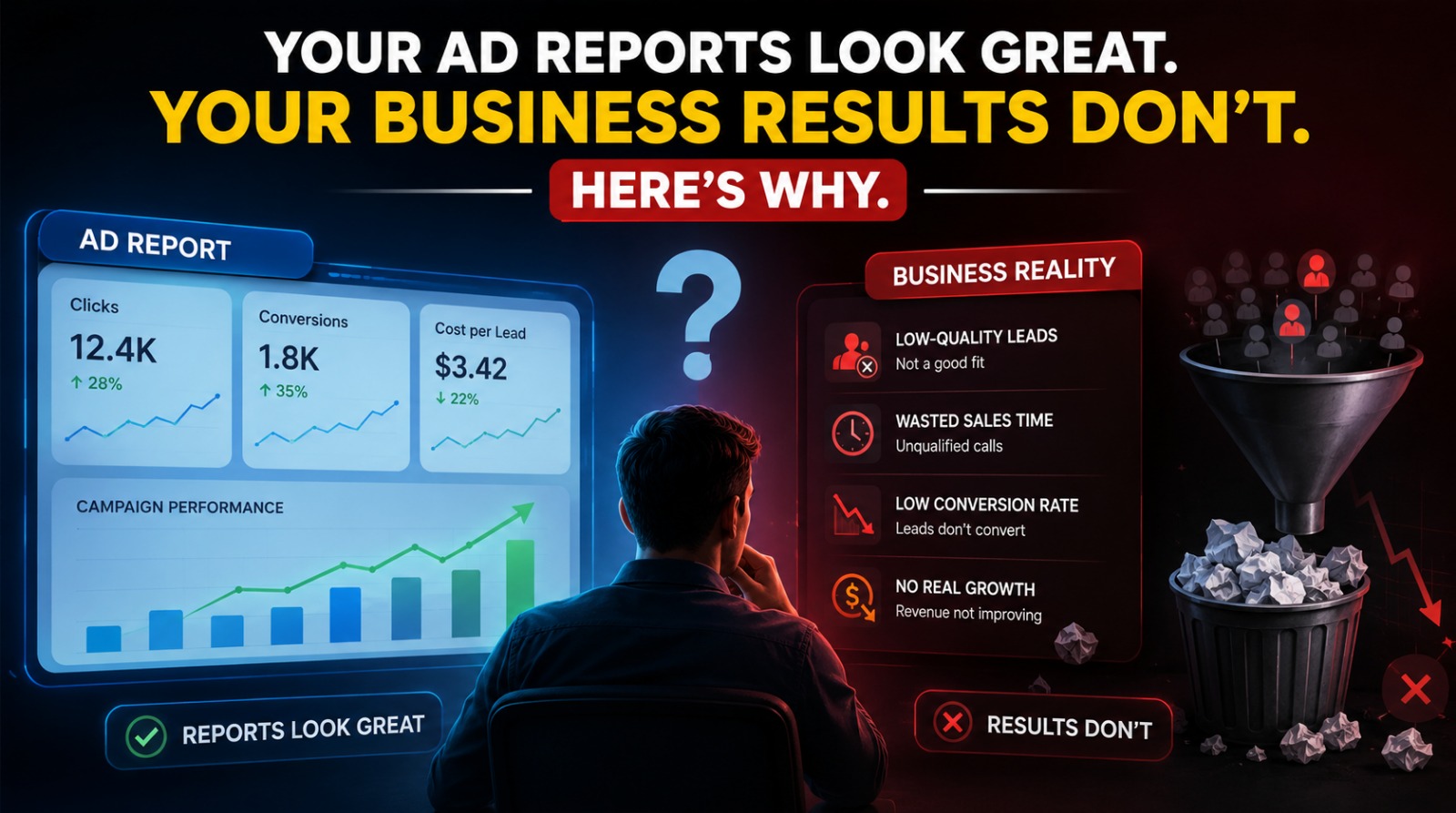
Your Ad Reports Look Great. Your Business Results Don’t. Here’s Why.
Why modern PPC success can’t be measured by conversions anymore — and what smart teams are doing instead
Your ad dashboard says everything is fine.
Clicks are coming in. Conversions are growing. Cost per lead is going down.
And yet, something feels off.
Sales calls go nowhere. Demo requests don’t convert. Your team spends time chasing people who were never a real fit in the first place. On paper, marketing is winning. In reality, the business isn’t moving.
This gap is becoming one of the biggest problems in digital advertising today.

The uncomfortable truth about “conversions.”
For years, conversions were the gold standard of performance marketing. If someone filled out a form, booked a call, or added a product to the cart, we counted it as success.
But advertising platforms have changed.
Google Ads, Meta, and other platforms now rely heavily on automation. Their systems are very good at finding people who complete actions. What they are not responsible for is whether those actions actually matter for your business.
The platforms don’t ask:
- Does this person have a budget?
- Are they a decision-maker?
- Are they even looking for the right service?
They only care about one thing: did the action happen?
That’s how conversions quietly turned into a vanity metric.
Automation isn’t broken — it’s just not on your side
This isn’t an anti-AI argument. Automation works exactly as designed.
Ad platforms optimize for what they can measure easily:
- form submissions
- clicks
- low-cost actions
They will always choose the fastest, cheapest path to a conversion. Sometimes that’s a real customer. Often, it’s not.
Students researching, competitors checking prices, bots, people outside your market — they all look the same to the platform if they complete the action.
From the platform’s perspective, the campaign is a success.
From the business perspective, it’s wasted effort.
The real problem: no connection between leads and reality
Most teams still evaluate campaigns inside the ad platform itself. That’s like judging a restaurant by how many people look at the menu, not by how many actually eat.
What’s missing is a layer between advertising and revenue — a system that understands quality, not just quantity.
This is where many modern marketing teams are changing direction.
From automation to interpretation
Instead of letting platforms define success, advanced teams now build their own logic on top of paid media.
The idea is simple:
- Ads generate demand
- Internal systems judge value
Every lead is evaluated beyond the click.
Not manually — that doesn’t scale — but through structured analysis that looks at signals and platforms ignored.
What does lead quality actually means
High-quality leads usually share clear patterns:
- They describe a real problem, not a vague request
- They come from relevant industries
- Their role matches the buying process
- Their intent is clear, specific, and realistic
Low-quality leads often:
- leave empty or generic messages
- Use personal or disposable emails
- have roles unrelated to purchasing
- Ask for services you don’t even offer
When you track these differences, something interesting happens:
campaigns that look “bad” in ad dashboards often drive the best business outcomes — and vice versa.
Seeing performance through a different lens
Instead of asking “Which campaign has the lowest cost per lead?”, smarter teams ask:
- Which campaign brings people our sales team wants to talk to?
- Which traffic source produces real conversations?
- Which ads lead to long-term revenue, not quick form fills?
When you compare campaigns in this way, priorities shift rapidly.
A campaign with fewer leads but higher intent suddenly becomes the most valuable one in the account.
Why this matters even more in 2026
As platforms become more automated, transparency keeps shrinking. You see fewer details, fewer controls, and more recommendations to “increase budget.”
Without your own system for judging quality, you’re forced to trust metrics that were never designed to represent business truth.
Marketing becomes busy — but not effective.
The teams that win now are not the ones spending more. They’re the ones measuring better.
A quiet shift is happening across marketing teams
At Friday Marketing Agency, we’ve seen this shift clearly across different industries. Teams are moving away from blind trust in platform numbers and toward deeper analysis of what happens after the click.
Not louder campaigns.
Not more dashboards.
Just better questions.
Advertising still brings people in. However, success is defined elsewhere — closer to sales, closer to revenue, closer to reality.
What comes next
Once you stop optimizing for conversions alone, a bigger question appears:
If leads can be misleading, what about revenue metrics?
What about ROAS, profit, margins, and real growth?
That’s where the next layer of modern marketing begins — and where most brands are still flying blind.


