

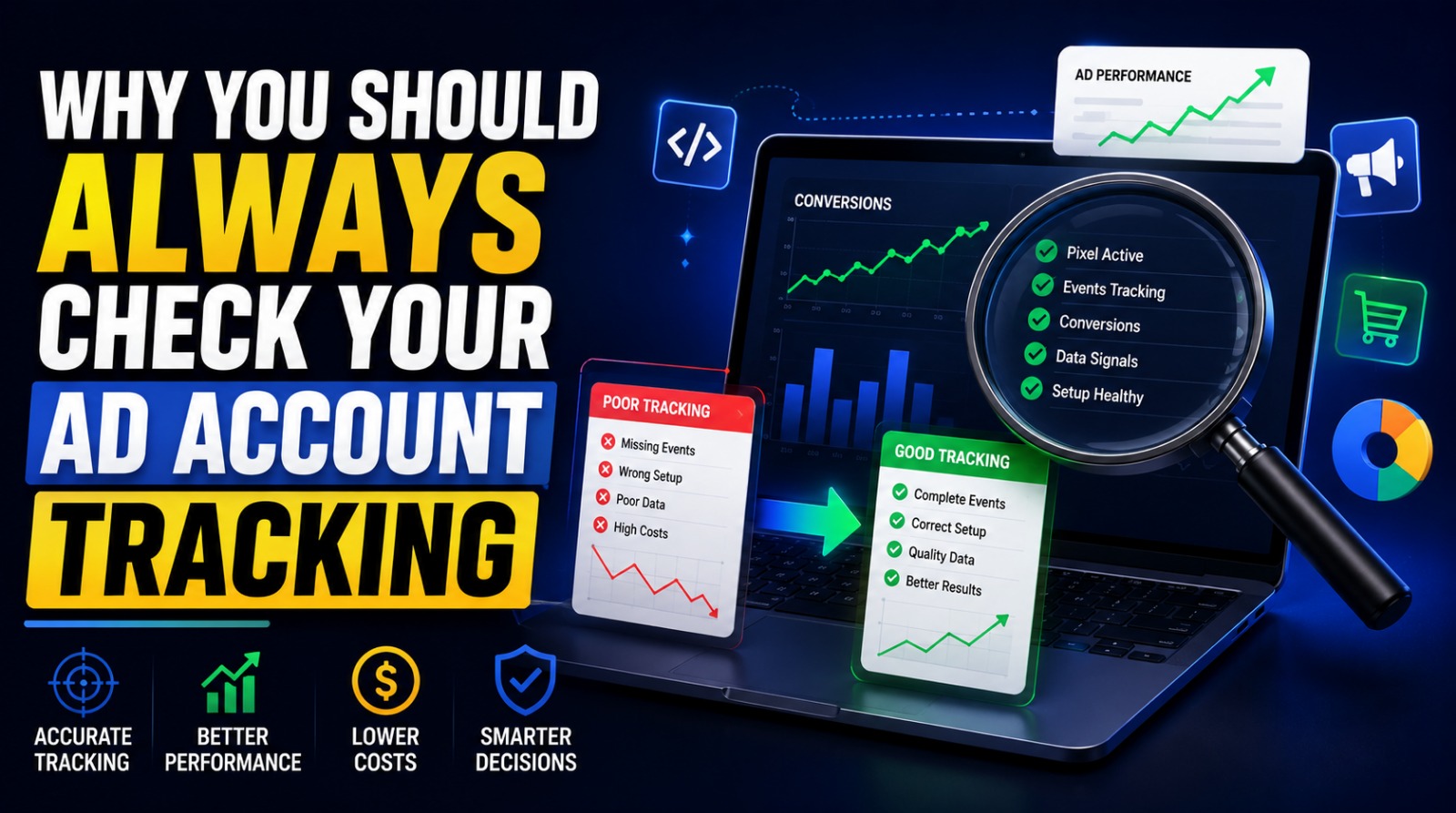
Why You Should Always Check Your Ad Account Tracking
Because great ads can fail when the setup is broken
In digital advertising, there is a belief that performance problems are always creative problems. When results drop, teams usually rush to change visuals, rewrite copy, test new formats, or blame the audience. But in reality, one of the most common reasons ads underperform has nothing to do with the ad itself.
It starts much earlier inside the ad account setup.
Tracking, pixel configuration, and event structure are often treated as technical details that can be “fixed later.” In practice, they are the foundation of everything. If this foundation is weak, even the best ads will struggle. If it’s strong, average ads can suddenly perform extremely well.

The hidden cost of incorrect tracking
One of the most underestimated issues in paid advertising is incorrect or incomplete tracking. Many ad accounts look “active” on the surface — campaigns are running, traffic is coming in, and leads are being generated. But when you look closer, the data tells a different story.
Pixels are often missing key events. Events fire incorrectly or not at all. Conversion actions are tracked in a way that doesn’t reflect real user behavior. In some cases, only one primary event exists, leaving the platform almost blind to what happens before that final action.
This creates a serious problem: the platform cannot optimize properly if it doesn’t understand the full journey.
When Meta doesn’t receive clean and complete signals, it guesses. And guessing is expensive.
Same ads, completely different results
There are many cases where advertisers reused the exact same ads, the same copy, the same visuals, and the same targeting — but achieved dramatically different results simply by fixing tracking and structure.
In some accounts, the cost per lead dropped from extremely high numbers to single digits without touching the ads at all. In others, the cost per booked class, registration, or purchase went from unsustainable levels to highly profitable — again, using the same creatives.
The only real change was the setup:
- Proper pixel installation
- Correct event mapping
- Logical campaign structure
- Multiple events instead of one isolated conversion
This shows something very important: performance is not only about persuasion. It is also about clarity.
Why multiple events matter
A common mistake is tracking only one main conversion for example, a purchase or a form submission. While this may seem logical, it actually limits the platform’s learning ability.
Meta works best when it can see the full funnel:
- Page views
- Content views
- Button clicks
- Add-to-cart actions
- Initiated checkouts
- Thank you for page visits
Each event provides context. Each signal helps Meta understand who is interested, who is close to converting, and who is most likely to take the final action.
When only one event exists, optimization becomes slow, unstable, and expensive. When multiple events are set up correctly, the system learns faster and allocates budget more intelligently.
Thank you pages and real confirmation
Another critical detail is confirmation tracking. Many accounts track form submissions or button clicks, but never confirm whether the action was actually completed.
A thank-you page is one of the cleanest ways to track real conversions. It removes false positives and ensures that every reported result represents a real user action.
Without this, campaigns may optimize for clicks that never turn into leads or purchases. On paper, numbers look fine. In reality, quality suffers.
Structure before scale
When performance is poor, the instinct is often to scale down, pause campaigns, or test new ideas immediately. But the smarter move is to audit the structure first.
A solid setup allows Meta to do what it is designed to do: optimize. Without that, every adjustment becomes guesswork.
This is why experienced teams prioritize:
1. Tracking accuracy
2. Event hierarchy
3. Campaign logic
4. Data consistency
Only after these are fixed does it make sense to adjust creatives, budgets, or targeting.
The real takeaway
Ad performance is not always about doing more. Very often, it’s about fixing what already exists.
If costs are high, leads are low-quality, or results feel unpredictable, the first question should not be “Do we need new ads?”
It should be: Is our tracking actually working the way we think it is?
Because when the foundation is right, everything else becomes easier and cheaper.
And sometimes, the biggest performance win isn’t a new idea, but a better setup.


