

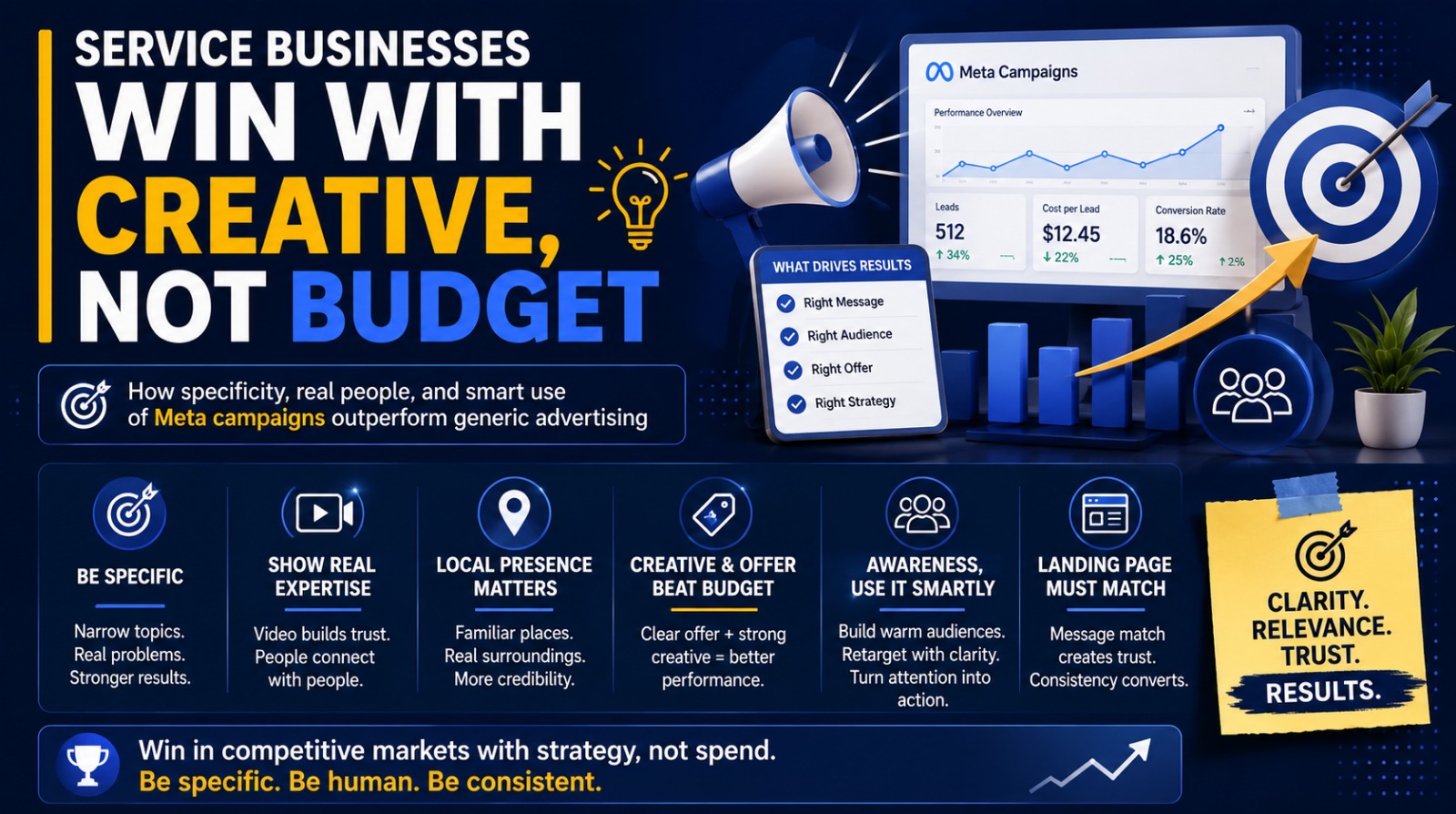
How Service Businesses Win With Creative, Not Budget
How specificity, real people, and smart use of Meta campaigns outperform generic advertising
Service businesses operate in one of the most competitive environments in advertising. Lawyers, consultants, financial advisors, real estate professionals — they all sell something that isn’t visual by nature and often isn’t emotionally exciting at first glance. At the same time, the cost of attention keeps growing, and budgets are rarely unlimited.
That’s exactly why creative strategy becomes more important than anything else.
When you look closely at campaigns that actually perform in competitive service sectors, one thing becomes very clear: success doesn’t come from being generic. It comes from being specific, human, and intentional — both in creatives and in how campaigns are structured.

Specificity Beats General Messaging
One of the biggest mistakes service businesses make is trying to speak to everyone at once. Ads that say things like “Professional legal services you can trust” may sound safe, but they blend into the background instantly. People scroll past them without even realizing what they saw.
What works far better is a highly specific creative that speaks to a real situation, a real person is already thinking about.
For example, instead of advertising “legal services,” a lawyer might focus on very concrete topics:
— drafting contracts
— setting up trust funds
— handling inheritance questions
— protecting assets before marriage
When someone sees an ad that directly reflects a concern already on their mind, attention changes. The ad doesn’t feel like advertising anymore it feels relevant.
Specificity also builds credibility. It silently communicates expertise. When a service business shows that it understands a precise problem, trust starts forming before a click even happens.
Why Video Matters Especially for Services
In competitive service industries, people don’t just buy a service. They buy confidence in the person behind it.
That’s why video creatives often outperform static visuals, especially when the professional appears on camera. A lawyer talking directly to the camera, explaining something clearly and calmly, creates a level of trust that no stock image ever could.
There’s also an important local factor here. Showing recognizable streets, neighborhoods, or familiar surroundings subtly reinforces legitimacy. It signals, “I’m real, I’m here, I work with people like you.” For local service businesses, this small detail can make a big difference in how an ad is perceived.
The goal of video in this case isn’t to be cinematic or perfect. It’s to be human, understandable, and believable.
Creative and Offer Matter More When Budgets Are Lower
When budgets are limited, there’s very little room for inefficiency. In these cases, the creative and the offer do most of the heavy lifting.
In Meta’s auction system, ads don’t just compete on budget. They compete on relevance, engagement, and how people react to them. A strong creative with a clear offer can outperform a higher-budget competitor simply because it connects better with the audience.
This is why, for smaller or more cautious clients, the focus should shift away from complex campaign structures and toward answering one simple question:
Why should someone care about this ad right now?
A clear offer, paired with a message that directly addresses a real need, often performs better than broad brand messaging — especially in the early stages.
The “Awareness” Problem (And How to Use It Properly)
Many clients are uncomfortable with the word awareness. To them, it sounds vague, expensive, and disconnected from real results. And honestly, that concern isn’t wrong at least not entirely.
Pure awareness campaigns usually make sense only for very large advertisers who are already running high volumes of conversion campaigns. For smaller businesses, running awareness just for the sake of it rarely delivers immediate value.
However, awareness becomes powerful when it’s used strategically.
For example, video-based awareness campaigns can be used to build warm audiences — people who watched a significant portion of a video, even if they didn’t click or convert. These audiences are extremely valuable later.
Instead of asking for a commitment immediately, the first step is simply exposure. Then, once someone has already seen and engaged with the message, a follow-up campaign can retarget them with a clear offer. At that point, the ad feels familiar rather than intrusive.
In this context, awareness isn’t the goal — it’s a tool.
Landing Pages Must Match the Creative
Another overlooked detail in service advertising is alignment between the ad and the landing page.
When an ad is highly specific — for example, about trust funds — sending users to a generic homepage breaks the experience. It creates friction and uncertainty. People wonder if they’re in the right place.
Creating separate landing pages that directly reflect the message of the creative makes a noticeable difference. The headline, content, and offer should feel like a natural continuation of the ad, not a new conversation.
This consistency reassures users and increases the chance they’ll take the next step.
Final Thought
In competitive service sectors, winning isn’t about louder ads or bigger promises. It’s about clarity, relevance, and trust.
Being specific, showing the human behind the service, focusing on strong creatives and real offers — especially when budgets are tight — and using awareness strategically rather than blindly, all work together to create campaigns that actually perform.
When every piece of the funnel speaks the same language, people listen. And in crowded markets, that’s what truly sets businesses apart.


