

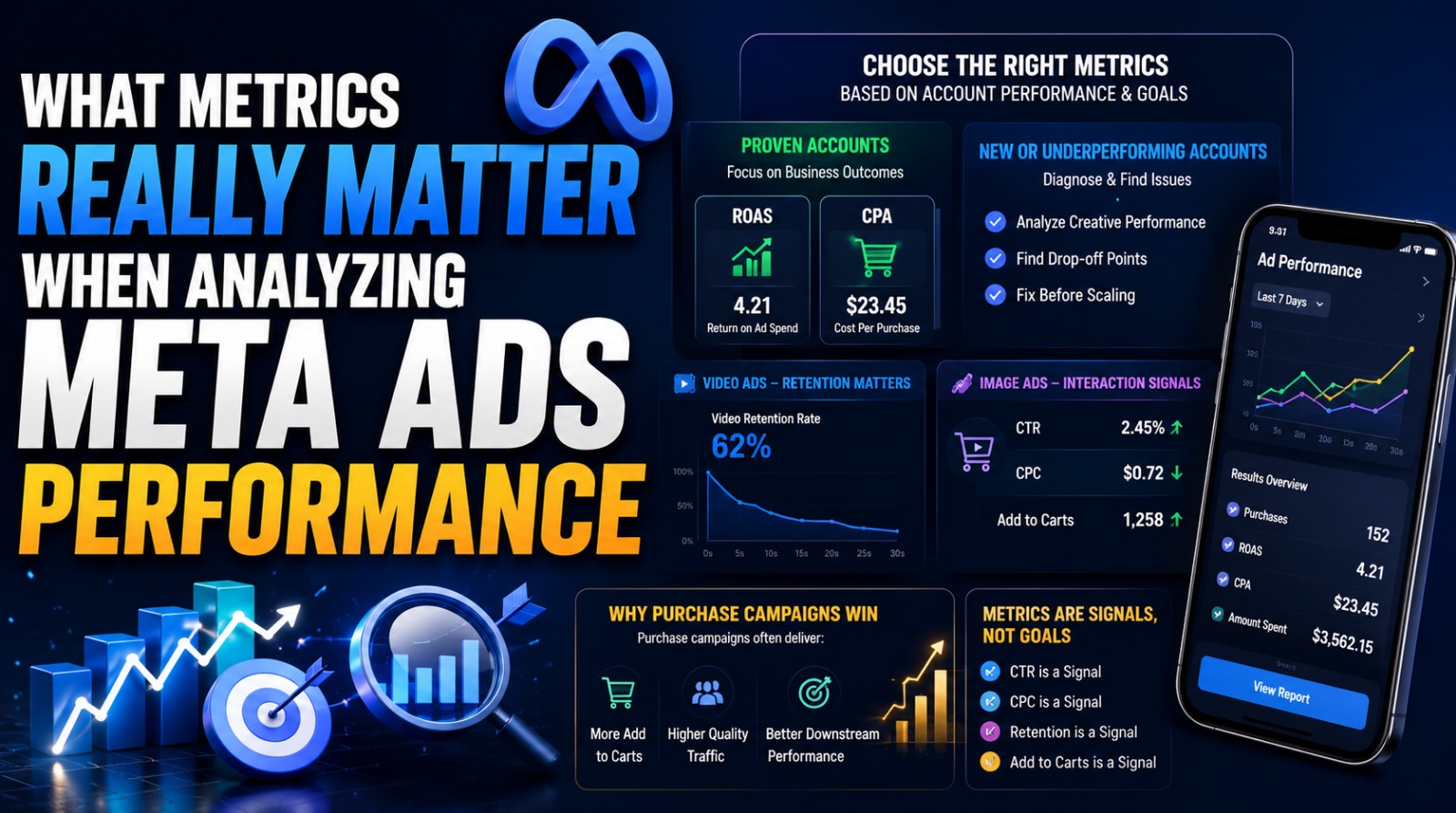
What Metrics Really Matter When Analyzing Meta Ads Performance
How to choose the right Meta ad metrics based on account performance and campaign goals
When analyzing Meta ads, one of the most common mistakes marketers make is trying to look at everything at once. Meta offers dozens of metrics, charts, and breakdowns, and while all of them can be useful, not all of them matter at the same time or for every account.
The key is understanding which metrics matter depending on the account’s stage and performance level. A proven, stable account should not be analyzed the same way as a new or struggling one. The signals you trust and the conclusions you draw must change based on context.

Start With Business Metrics for Proven Accounts
For accounts that already have consistent data and stable performance, analysis should begin with business outcomes, not surface-level engagement metrics.
Two numbers usually tell most of the story:
- ROAS (Return on Ad Spend)
- Cost Per Purchase (CPA)
If these two metrics are strong and stable, the account is doing its job. At that point, digging too deeply into secondary metrics can actually create confusion rather than clarity. A slightly lower CTR or a higher CPC doesn’t necessarily mean something is wrong if purchases are coming in efficiently.
For proven accounts, ROAS and CPA reflect the entire system working together: targeting, creatives, optimization, and budget distribution. These metrics show whether the ads are profitable, not just active.
When ROAS and CPA Are Weak, Go Deeper
The situation changes when you’re working with:
- A new ad account
- An account with limited data
- An account that is underperforming
In these cases, ROAS and CPA alone don’t tell you enough. The system hasn’t fully learned yet, or something in the funnel is breaking before the purchase happens. This is when creative-level metrics become critical.
Instead of asking, “Is this profitable?”, the better question becomes:
“Where are people dropping off?”
Analyzing Video Creatives: Retention Matters
For video ads, video retention rate is one of the most important early signals.
It tells you:
- Whether the hook is working
- Whether the message holds attention
- Whether people are interested enough to keep watching
If users drop off in the first few seconds, the problem is not targeting or optimization — it’s the creative itself. A low retention rate usually means:
- The opening isn’t strong
- The message isn’t clear
- The ad doesn’t feel relevant to the audience
Before expecting conversions, a video must first earn attention. Without that, no optimization can fix performance.
Image Ads: Look at Interaction Signals
For image-based creatives, attention is measured differently. Since there’s no playback, analysis shifts toward interaction and intent metrics, such as:
- CTR (Click-Through Rate)
- Cost Per Click (CPC)
- Number of Add to Carts
CTR helps you understand whether the creative and message resonate enough to generate curiosity. CPC adds another layer by showing how expensive that curiosity is. Together, they indicate whether users are responding positively to what they see.
Add to carts, however, introduce a more meaningful signal. They show purchase intent, even if the final conversion hasn’t happened yet.
If users are clicking but not adding to cart, the issue may lie on the landing page, pricing, or product clarity. If they are adding to cart but not purchasing, checkout friction or trust issues may be the problem.
Why Purchase Campaigns Often Perform Better Overall
A key insight worth highlighting is that purchase-optimized campaigns often outperform campaigns optimized for earlier funnel events, even when analyzing those same events.
In practice, purchase campaigns frequently generate:
- More added to carts
- Higher-quality traffic
- Better downstream performance
This happens because Meta’s algorithm prioritizes users who are more likely to complete the final action. When you optimize for purchases, the system looks for individuals who have historically progressed through the entire funnel, not just those who click or browse.
As a result, even upper-funnel actions, such as adding to carts, can perform better under purchase optimization than under a dedicated add-to-cart campaign.
Metrics Are Signals, Not Goals
One of the most important mindset shifts in Meta ads analysis is understanding that not every metric is a goal.
- CTR is a signal
- CPC is a signal
- Video retention is a signal
- Add to carts are a signal
The goal is business growth.
Metrics should be used to diagnose issues, not to chase vanity improvements. A “good” CTR means nothing if purchases don’t follow. A high add-to-cart count doesn’t matter if ROAS is negative.
Putting It All Together
Effective Meta ads analysis is not about looking at more data — it’s about looking at the right data at the right time.
- For proven accounts, focus on ROAS and CPA
- For new or underperforming accounts, analyze creative performance first
- Use video retention for videos
- Use CTR, CPC, and add to carts for images
- Trust purchase campaigns to drive stronger overall performance
When you align metrics with account maturity and campaign goals, analysis becomes clearer, decisions become faster, and performance improves more predictably.


