

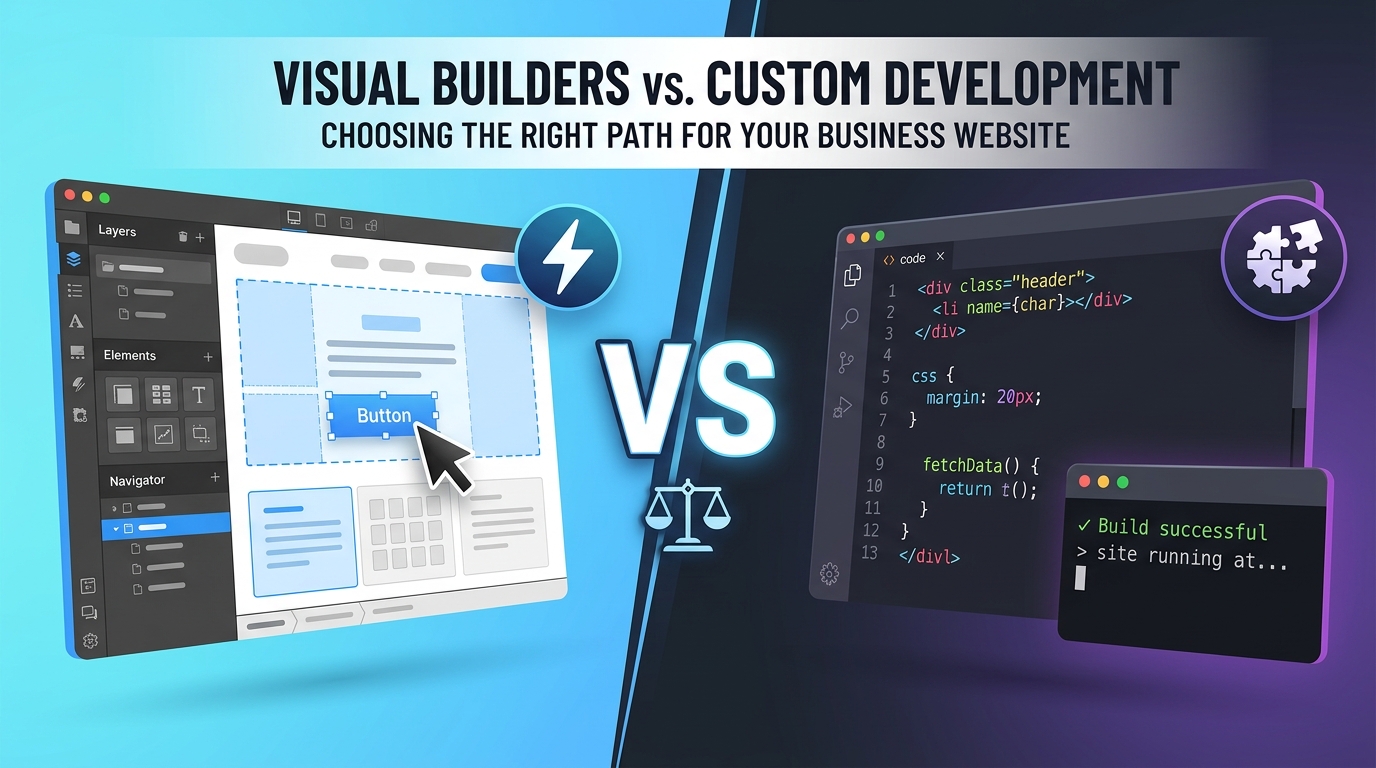
Webflow vs. Custom Development: Which Is Right for Your Business Website?
Choosing the right technology for your business website can have a big impact on your budget, timeline, performance, and ability to grow.
For some businesses, Webflow offers the right balance of design freedom and easy content management. For others, custom development makes more sense because they need advanced features, unique integrations, or complete control over how their website works.
So, which option should you choose?
There is no single answer for every business. The right choice depends on what you need your website to do today and where you expect it to go in the future.
This guide compares Webflow and custom development to help you make a more informed decision.
What Is Webflow?
Webflow is a visual website development platform that allows designers and developers to build responsive websites without creating every part of the code from scratch.
It gives businesses a way to create highly designed websites while also providing tools for content management, responsive layouts, animations, and other features.
For businesses that want a polished marketing website without a large custom software project, Webflow development services Beverly Hills can be worth considering.
Webflow can be particularly useful for:
- Marketing websites
- Professional service businesses
- Portfolio websites
- Landing pages
- Content-driven websites
- Brand websites
- Businesses that need frequent content updates
One of its biggest advantages is the balance between visual control and development capabilities.
What Is Custom Website Development?
Custom development means creating a website around the specific requirements of your business rather than relying mainly on a pre-built platform.
A custom website can be built using different technologies and programming languages depending on the project's needs.
This approach may involve both frontend and backend development.
The frontend is what visitors see and interact with. The backend handles things such as databases, business logic, user accounts, APIs, and other systems running behind the scenes.
Custom website development in Beverly Hills can therefore be a better fit when a business needs functionality that goes beyond what a standard website platform can reasonably provide.
Webflow vs. Custom Development: The Key Differences
The best choice becomes clearer when you compare the two options based on the things that matter most to your business.
1. Design flexibility
Webflow gives designers significant control over the visual appearance of a website.
You can create custom layouts, responsive designs, animations, interactions, and branded experiences without starting every element from a blank codebase.
Custom development can provide even more control because the website can be built specifically around your requirements.
However, greater control can also mean more development time and a larger budget.
Best for design flexibility: Both, depending on the project.
Webflow is often enough for highly customised marketing websites. Custom development becomes more valuable when the design needs to work alongside complex functionality.
2. Development time
Webflow can reduce development time because it provides an established platform and visual tools.
A project can often move from design to launch without building every core website function from scratch.
Custom development usually takes longer because developers need to build, test, and maintain more of the underlying system.
If you need a website launched quickly, Webflow may have an advantage.
However, speed should not be the only consideration. Building a website quickly does not help if the platform cannot support what you need later.
3. Cost
The cost of a website depends on its size, features, design, content, integrations, and development requirements.
Webflow can be more cost-effective for businesses that need a professional marketing website without complex custom functionality.
Custom development generally requires more development hours, which can increase the initial investment.
That does not automatically make custom development poor value.
If your website is an important part of your business operations, paying more for the right technology may save time and money later.
The key is to compare the total value and long-term cost, not just the initial project price.
4. Content management
Many businesses need to update their website regularly.
Marketing teams may need to add:
- Blog posts
- Case studies
- Service pages
- Team profiles
- New projects
- Campaign landing pages
Webflow provides content management tools that can make these updates easier for non-developers.
With a fully custom website, the content management experience depends on how the system has been built. A custom CMS can be created around your workflow, but this requires additional planning and development.
If your team wants to make regular website changes without relying heavily on developers, Webflow can be a strong option.
5. Functionality and integrations
This is where custom development can have a major advantage.
If your website needs unusual functionality, complex integrations, custom user accounts, advanced calculations, or connections to internal business systems, custom development may offer greater flexibility.
Full-stack development services can be useful for projects where the frontend experience needs to connect with a custom backend or other systems.
Examples might include:
- Customer portals
- Custom booking systems
- Membership platforms
- Complex databases
- Advanced calculators
- Custom APIs
- Internal business tools
- Unique e-commerce functionality
Webflow supports integrations and custom functionality, but there are situations where building a dedicated system is more practical.
6. Scalability
Think about where your business will be three to five years from now.
A simple marketing website today could eventually become a much larger digital platform.
Webflow can scale well for many business websites, particularly when the main purpose is marketing, content, lead generation, or brand communication.
Custom development may be the better option when your website is expected to become a core business application with complex functionality.
The important question is not:
“Which platform can handle the most?”
Instead, ask:
“What does my business actually need now, and what might it realistically need later?”
Overbuilding a website can waste money. Underbuilding one can create expensive problems later.
7. Maintenance and updates
Every website needs ongoing maintenance.
Webflow manages much of the underlying platform infrastructure, which can reduce some of the technical maintenance work businesses would otherwise need to manage themselves.
Custom websites require more direct attention to the codebase, integrations, security updates, hosting environment, and other technical components.
This doesn't mean custom websites are difficult to maintain. It simply means you should plan for ongoing technical support.
When Should You Choose Webflow?
Webflow may be a good choice if you need:
- A professional marketing website
- Strong visual design
- Responsive layouts
- A flexible content management system
- Fast development
- Landing pages
- Blog and content functionality
- A website your marketing team can update
- A strong brand experience without complex backend systems
For these projects, Webflow development services can provide a practical path from design to launch.
When Should You Choose Custom Development?
Custom development may make more sense when you need:
- Complex business functionality
- Custom databases
- Advanced integrations
- Customer portals
- Unique user experiences
- Complex e-commerce requirements
- Custom APIs
- Special workflows
- Advanced backend systems
- A website that is also a business application
In these cases, custom website development Beverly Hills can provide the control needed to build around your specific requirements.
What About Frontend vs. Full Stack Development?
It is also important to understand the difference between frontend and full stack development.
Frontend development focuses on the part of a website that visitors interact with. This includes layouts, navigation, forms, animations, buttons, and responsive behavior.
Full stack development covers both frontend and backend systems.
If you only need a highly polished customer-facing website, frontend development may cover much of the project.
If your website needs databases, APIs, authentication, custom business logic, or complex integrations, you may need full stack expertise.
For businesses looking for frontend development services Glendale, the right solution depends on the complexity of the user experience and the technology behind it.
Webflow vs. Custom Development: Which Should You Choose?
Here is a simple way to think about the decision:
Of course, some projects can use a combination of technologies.
The goal isn't to choose the most advanced option. It is to choose the technology that supports your business without creating unnecessary complexity.
Questions to Ask Before Choosing
Before you start a website project, ask yourself:
What is the main purpose of the Website?
Is it primarily designed to generate leads, showcase your brand, sell products, publish content, or run part of your business?
Who will manage the website?
If your marketing team will make regular updates, ease of content management may be important.
What integrations do you need?
Make a list of the tools and systems your website needs to connect with before choosing a platform.
Will the website become more complex?
Think about realistic future requirements, but don't pay for functionality you may never use.
What is your budget?
Consider both the initial build and ongoing costs.
Need Help Choosing the Right Development Approach?
Choosing between Webflow and custom development doesn't have to be a technical guessing game.
The right approach starts with understanding your business goals, audience, functionality, content needs, and long-term plans.
Friday Marketing Agency brings together website design, development, digital marketing, content, social media, and paid advertising under one roof. If you're unsure whether Webflow or a custom-built website is the right fit, the team can help you assess your requirements and choose an approach that supports your goals.
Talk with the team about your website project and find the right development path for your business.
Frequently Asked Questions
Is Webflow better than custom development?
Neither option is automatically better. Webflow can be ideal for professional marketing websites and content-driven projects, while custom development may be better for complex functionality, integrations, and business applications.
Is Webflow good for business websites?
Yes. Webflow can be a strong choice for businesses that want responsive design, visual flexibility, content management, and a professional online presence without building an entire website platform from scratch.
Is custom website development more expensive than Webflow?
It can be, particularly when a project requires extensive backend development, integrations, testing, and ongoing technical support. The final cost depends on the website's requirements.
Can Webflow handle custom functionality?
Webflow supports custom code, integrations, and various third-party tools. However, highly complex functionality may be better suited to a custom development approach.
When should a business choose full stack development?
Full stack development can be appropriate when a website needs both a custom frontend and backend functionality, such as databases, user accounts, APIs, custom workflows, or business systems.
Can I migrate from Webflow to a custom website later?
Migration may be possible, but the difficulty depends on the website's structure, content, functionality, integrations, and how the new system is designed. It is worth considering future requirements before choosing your initial platform.
How do I choose between Webflow and custom development?
Start with your business goals and website requirements. Consider functionality, integrations, content management, budget, development time, maintenance, and realistic future needs before choosing a platform.
Are Webflow development services suitable for small businesses?
They can be. Webflow may be a practical option for small and growing businesses that need a professional, responsive website with strong design and manageable content updates without requiring a complex custom application.


