

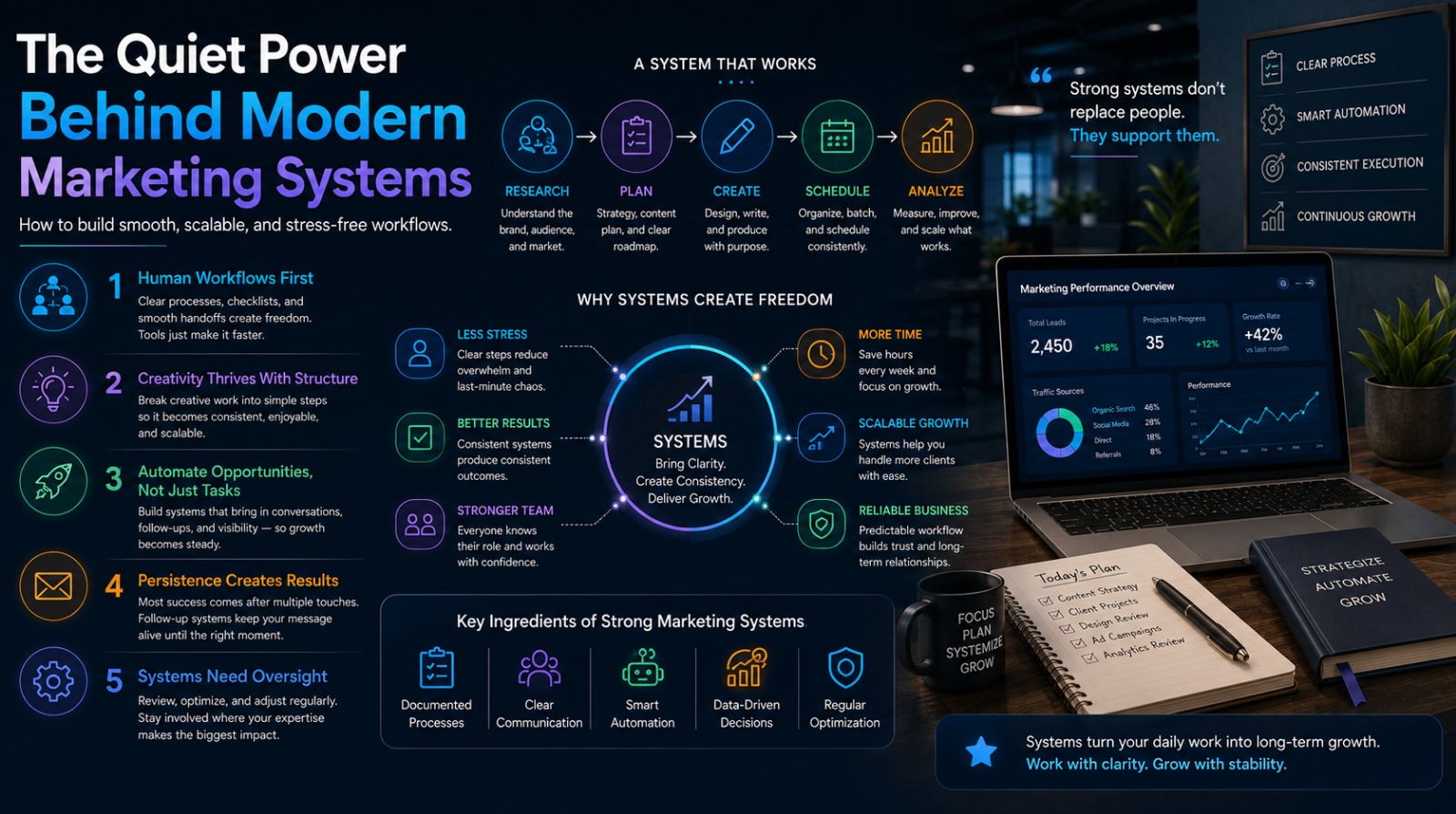
The Quiet Power Behind Modern Marketing Systems
How to build smooth, scalable, and stress-free workflows.
When people talk about successful marketing, they usually point to talent, creativity, or hustle. But in reality, the biggest wins often come from something much less glamorous: calm, predictable systems.
The kind of systems that keep the work moving, keep the team aligned, and let a business grow without burning anyone out.
This is where digital marketing becomes more than design trends, ads, and analytics. It becomes an organized engine — one that supports the work instead of draining your energy.
Below are five practical lessons any business can use to create more structure, more clarity, and more time.

1. The most reliable “automation tool” is still a human workflow
Software is helpful, but software alone doesn’t run a business. What actually creates order is a clear workflow that a team can follow without needing constant supervision.
Think of it like this:
When a new project comes in whether it’s a website, a social media calendar, or a full branding package — the goal isn’t to finish tasks faster. The goal is to make sure everyone knows what happens next.
In many agencies, this is handled through simple but powerful systems:
- a project moves from sales → project manager → creative team
- every step has its own checklist
- every handoff is documented
- nobody waits for instructions
- nobody interrupts the business owner
You don’t build freedom through tools.
You build it through clarity.
Tools just help the system move faster.
2. Even creative work becomes easier when it has a structure
People often assume creativity cannot be organized. But the truth is, the most consistent creative work comes from teams that use simple, repeatable processes.
For example, many agencies treat content creation as a “flow of inspiration.” But professionals break it down into clear steps:
1. Research the brand voice
2. plan the topics for the month
3. Write all the captions in one session
4. design visuals in batches
5. Schedule everything in a content planner
This doesn’t kill creativity it protects it.
Because when the routine is predictable, the creative decisions become lighter and more enjoyable.
The same applies to SEO, ads, design, or any service that looks complex from the outside. Once you divide the work into stages, the entire process becomes replicable, measurable, and scalable.
3. Automate the flow of new opportunities, not just the tasks
Most business owners start by automating small tasks scheduling posts, sending reminders, organizing files. But the real shift happens when you automate the flow of new clients.
A business grows only when conversations grow.
That’s why many agencies build systems that run daily in the background:
- simple outreach campaigns
- automated follow-ups
- appointment-setting sequences
- Ongoing visibility on social platforms
- consistent newsletters
When these engines run smoothly, the agency no longer depends on random referrals or bursts of motivation. Growth becomes steady instead of stressful.
Automation isn’t about working less
it’s about never losing momentum.
4. Most people stop before the moment success usually happens
In digital marketing, the magic rarely happens on the first try. Whether you are posting content, emailing prospects, or running ads, results almost always come from persistence.
One post won’t change anything.
One message won’t open a door.
One offer won’t build a business.
This is why follow-up systems matter so much.
Modern platforms let you create sequences that politely and consistently remind people of your message. These systems work quietly in the background, keeping your brand present even when you’re busy with something else.
Success often comes on the second, third, or fifth touch —
but you only reach that point if the system keeps going.
5. “Set it and forget it” sounds nice, but real systems need attention
Automation is helpful, but no healthy business runs on autopilot forever.
Every strong marketing system needs regular check-ins:
- Are clients responding the same way they did before?
- Is the content still aligned with the brand?
- Are the ads bringing in the right leads?
- Are team handoffs still smooth and clear?
Even the best workflows need adjustments as the business evolves.
The goal isn’t to disappear it's to step in only when your expertise is needed.
Strong systems give you space.
Smart oversight keeps everything sharp.
The real advantage of systems
Marketing becomes easier the moment your daily work stops depending on your mood, your energy, or your availability. Systems give structure to creativity, direction to teamwork, and growth stability.
They don’t replace people — they support them.
They don’t limit creativity — they protect it.
They don’t remove responsibility — they make it lighter.
The strongest agencies in the world succeed not because they work harder, but because their systems work with them.


