

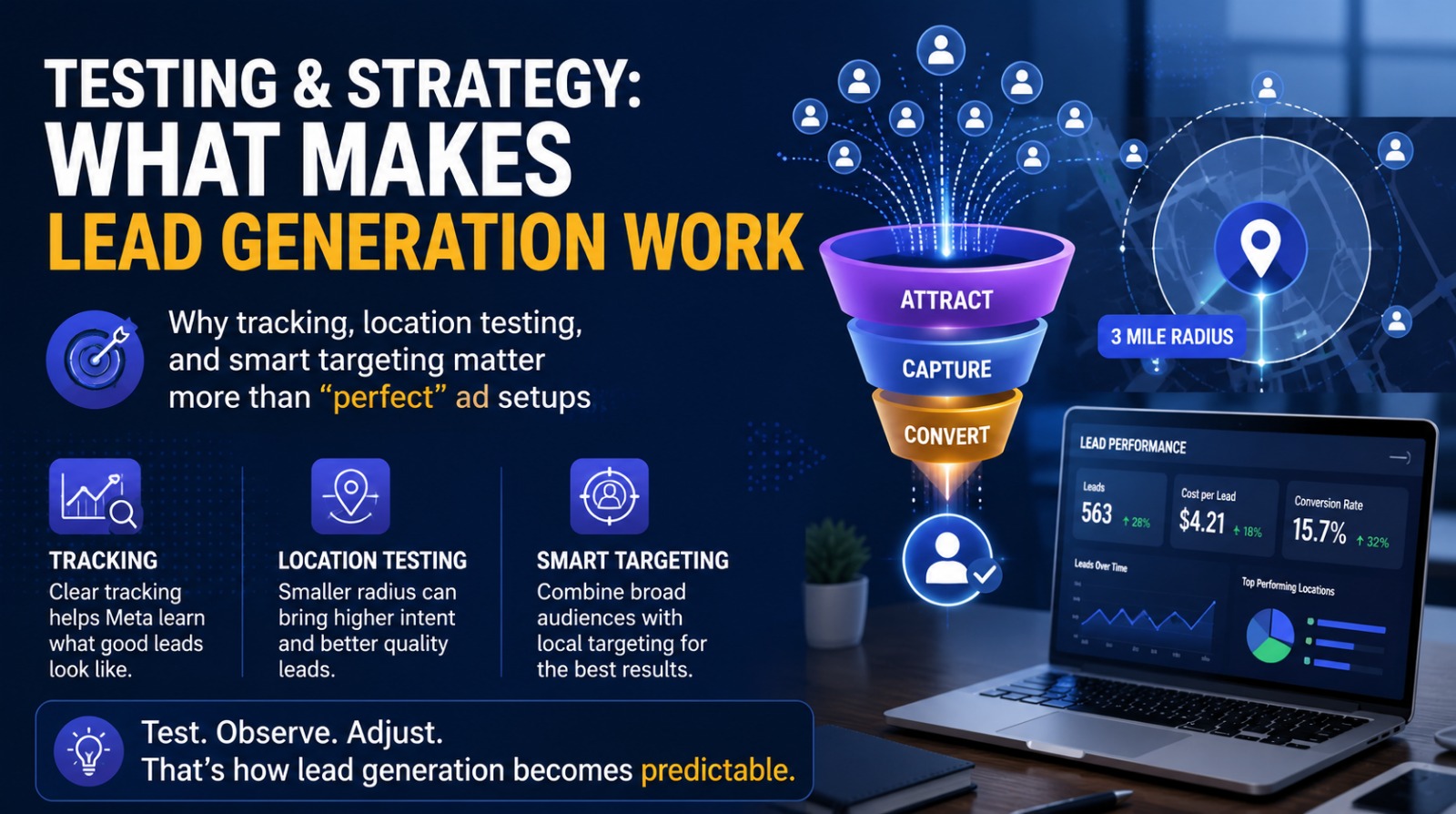
Testing and Strategy: What Makes Lead Generation Work
Why tracking, location testing, and smart targeting matter more than “perfect” ad setups
Lead generation looks simple on the surface. You launch ads, people click, forms get filled, and leads come in. But anyone who has worked seriously with Meta ads knows this is never how it actually goes. Real lead generation is not about one perfect setup. It’s about testing, observing, fixing small details, and letting the platform learn from real data.
One important mindset to have from the start is this: Meta is a testing platform. There is no single correct strategy that works forever. What works this month might stop working next month. That’s why the main goal is not just to “run ads,” but to constantly test and improve how leads are generated.
The real objective is simple — getting leads that are actually useful. Not just numbers in a report, but people who are likely to book, call, or show up.

Why Tracking Is the Foundation of Everything
Before talking about targeting, locations, or budgets, one thing must be clear: without proper tracking, Meta can’t optimize properly. If the system doesn’t understand what a successful lead looks like, it will guess. And guessing almost always means lower quality.
The most reliable way to track lead success is through a clear success action. Ideally, this is a success URL that loads after a form is submitted or a booking is completed. This tells the pixel, very clearly, “This is what we want more of.”
When a success page isn’t available yet, tracking can still be done through a submit button or a form submission event. It’s not perfect, but it’s better than having no signal at all. In some cases, creating a dedicated success page becomes the best long-term solution, because it removes confusion for both tracking and optimization.
Once events are set correctly, Meta starts learning from real behavior instead of clicks or impressions. This is where performance usually begins to improve.
Location Targeting: Smaller Can Be Smarter
One of the most interesting observations in lead generation often comes from location testing. It’s very common to assume that wider targeting means more opportunities. But in practice, this isn’t always true.
In some campaigns, narrowing the location radius — for example, to a three-mile area around a clinic or business — can result in more qualified leads than targeting a much wider area like 10 or 15 miles. People closer to the location tend to be more serious, more likely to show up, and more familiar with the area.
This doesn’t mean broad targeting is wrong. It means that proximity matters, especially for local services. When people feel that a business is “near them,” the barrier to taking action is lower.
Testing a smaller radius can reveal surprising results: fewer leads overall, but higher intent and better conversion after the lead comes in.
Broad Targeting Still Has a Role
At the same time, broad targeting should not be ignored. Broad audiences allow Meta to use its algorithm properly — but only when the pixel is receiving quality data.
When events are set up correctly, broad targeting gives the system freedom to find patterns humans can’t see. It can identify users who behave like converters, even if they don’t fit obvious interests or demographics.
The key is balance. A strong strategy often includes both:
- A narrow location-based ad set that focuses on nearby, high-intent users
- A broader ad set that allows Meta to explore and optimize at scale
Running these side by side gives clear insights into what actually performs better, instead of relying on assumptions.
Why Testing Is Not Optional
Testing is not something you do once and forget. It’s a continuous process. Location size, targeting type, tracking method — all of these can and should be tested over time.
Meta needs data to improve. If it doesn’t receive consistent signals, performance will stall. That’s why having proper events on the website is not a “technical detail,” but a core part of strategy.
When the system understands what a good lead looks like, it becomes much better at finding more of them. Without that understanding, even the best creatives and offers struggle.
The Bigger Picture
Good lead generation is not about chasing hacks or copying someone else’s setup. It’s about building a structure that allows learning. Clear tracking. Thoughtful targeting. Smart testing.
Sometimes a small change like narrowing a location radius or fixing a success event can make a bigger difference than increasing the budget or changing creatives.
In the end, successful Meta campaigns are built on patience and clarity. Test, observe, adjust, and let data guide decisions. That’s how lead generation stops being random and starts becoming predictable.


