

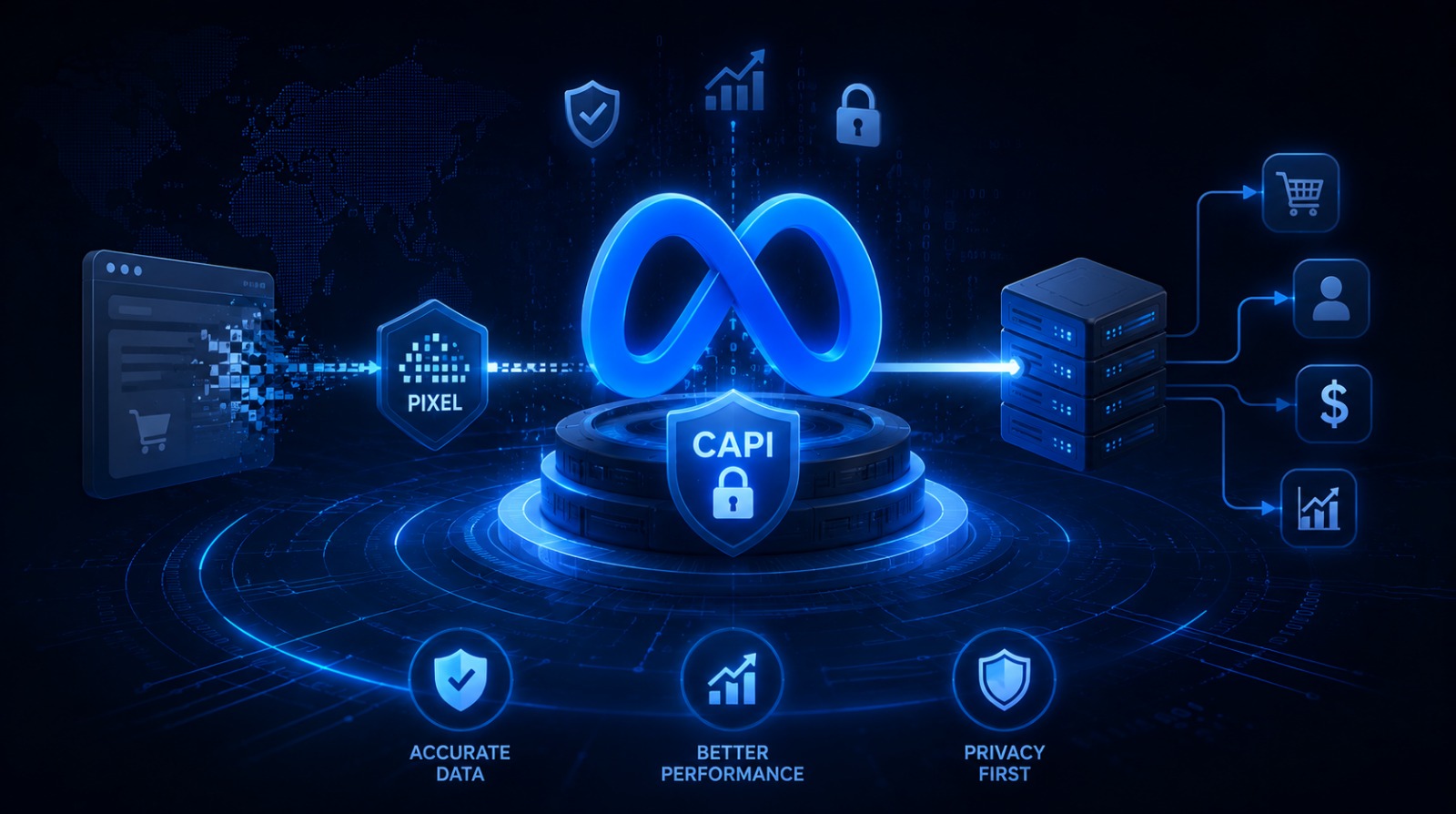
Meta Conversions API in 2026: Why Smart Brands Are Moving Beyond the Pixel
How server-side tracking is reshaping performance marketing and protecting your ad results
Digital advertising in 2026 doesn’t look like it did even two years ago. Cookies are disappearing. Browsers are stricter. Privacy rules are tighter. And yet — brands still need accurate data to scale profitably.
This is exactly why the Meta Platforms Conversions API (CAPI) has become one of the most important tools in modern performance marketing.
If you’re running ads on Meta Ads and still relying mainly on the Pixel, you’re probably seeing gaps in your tracking. And those gaps cost money.
Let’s break down what’s really happening and why CAPI matters more than ever.

What Is Meta Conversions API (CAPI)?
Meta Conversions API is a server-side tracking solution that sends customer events directly from your website or CRM server to Meta’s advertising system.
Unlike the Meta Pixel, which depends on browser tracking, CAPI creates a direct data connection. That means:
- Fewer lost conversions
- Better attribution
- More reliable reporting
- Stronger optimization signals
In simple terms: instead of hoping the browser passes the data correctly, your server delivers it directly.
And that changes everything.
Why CAPI Is Essential in 2026
1. The Post-Cookie Reality
Third-party cookies are fully deprecated across major browsers. Traditional browser tracking simply isn’t dependable anymore.
Server-side tracking doesn’t rely on cookies the same way — which makes it more stable and more future-proof.
2. Better Data Accuracy
CAPI bypasses common tracking disruptions like:
- Ad blockers
- Browser privacy restrictions
- iOS tracking limitations
- Weak internet connections
The result? More captured conversions and stronger signal quality for Meta’s algorithm.
3. Stronger Algorithm Performance
Meta’s machine learning thrives on clean, consistent conversion data.
When your events are more accurate:
- Targeting improves
- Lookalike audiences perform better
- Cost per acquisition decreases
- ROAS becomes more predictable
In competitive ad markets, signal quality is a serious advantage.
Key CAPI Capabilities in 2026
Meta has expanded CAPI significantly. Businesses can now send:
- Hashed email and phone data
- Location information
- External customer IDs
- Subscription and lead identifiers
- Offline conversions
The platform also automatically deduplicates events between Pixel and CAPI — so you don’t double-count purchases.
For many brands, the easiest implementation method is via partner integrations, such as:
- Shopify
- WooCommerce
- Salesforce Commerce Cloud
- HubSpot
- Google Tag Manager (server-side)
For more advanced setups, businesses can deploy the Conversions API Gateway through Meta’s Events Manager.
Best Practices for High-Performance CAPI Setup
If you want results — not just implementation — focus on these essentials:
Use Pixel + CAPI together
Redundant tracking improves reliability when properly deduplicated.
Maximize event data quality
Send hashed customer information (with consent), accurate timestamps, and consistent event naming.
Monitor Event Match Quality (EMQ)
An EMQ score above 8 typically correlates with stronger campaign performance.
Prioritize high-impact events
Start with Purchase, Lead, Add to Cart, Initiate Checkout, and Complete Registration.
Privacy Still Comes First
In 2026, compliance is not optional.
Your implementation must align with GDPR, CCPA, and evolving regional privacy laws. That means:
- Collecting clear user consent
- Hashing sensitive data before transmission
- Updating privacy policies transparently
- Respecting opt-out preferences
Good data and ethical data must go hand in hand.
The Bigger Picture: First-Party Data Is the Future
Meta’s ecosystem — including Instagram, WhatsApp, and Threads — continues to integrate deeper first-party data capabilities.
Brands that build strong internal data systems today will be far more resilient tomorrow.
CAPI isn’t just a technical upgrade.
It’s a strategic shift toward owned data, cleaner attribution, and scalable growth.
The Real Question Isn’t “Should You Use CAPI?”
It’s whether you can afford not to.
When tracking breaks, optimization suffers.
When optimization suffers, costs rise.
And when costs rise, scaling becomes unpredictable.
Smart brands are investing in infrastructure — not just creatives.
Written by Friday Marketing Agency 🚀


