

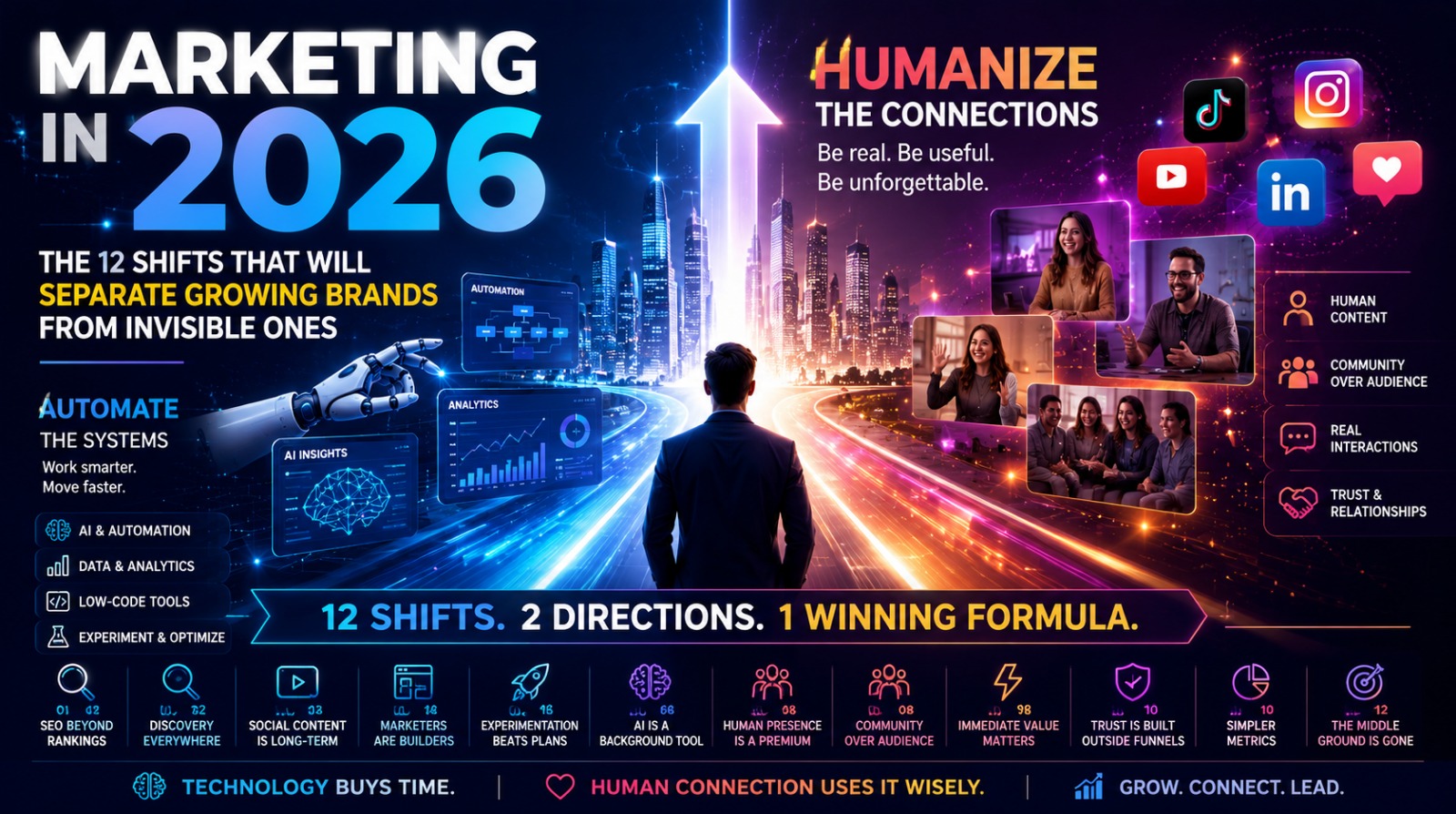
Marketing in 2026: The 12 Shifts That Will Separate Growing Brands From Invisible Ones
What is changing in modern marketing
Marketing didn’t suddenly change in 2026.
It finished changing.
The last few years were a transition period. Old strategies still worked — but were weaker. New tools looked impressive — but felt experimental. Many brands stayed in the middle, waiting for certainty.
That middle no longer exists.
By 2026, marketing will have clearly split into two directions:
- highly automated systems working quietly in the background
- very human, very visible communication happening front and center
Brands that grow are not choosing one over the other. They are learning how to use both, intentionally.
Below are 12 marketing shifts shaping 2026, written for teams that want clarity, not hype.

1. SEO Is No Longer Just About Rankings
Search hasn’t disappeared — but its role has changed.
People no longer search only to click links. They search to get answers immediately. AI-powered interfaces now summarize content directly, often without sending users to a website at all.
What matters in 2026 is not just being found, but being trusted enough to be referenced.
Content needs to be:
- clear
- structured
- accurate
- written by real experts
Brands that win are the ones AI systems confidently quote.
2. Discovery Happens Everywhere, Not Just on Google
Search behavior is fragmented — and that’s permanent.
People now “search” inside:
- TikTok for tutorials
- Instagram for inspiration
- YouTube for deep explanations
- Pinterest for visual ideas
Every platform is a search engine now.
If your content is not designed to be found inside platforms, you are invisible to entire audiences — especially younger ones.
3. Social Content Is Long-Term, Not Disposable
Short-lived viral content is no longer the goal.
In 2026, brands treat social posts like searchable assets:
- Captions are intentional
- on-screen text is optimized
- Videos answer specific questions
The best-performing content is useful today and discoverable months later.
4. Marketing Teams Are Becoming Builders
Waiting on development teams for simple tools is slowing brands down.
Modern marketers are now:
- building landing pages
- launching calculators
- creating quizzes
- testing ideas quickly
Low-code and no-code platforms removed the technical barrier. Curiosity matters more than perfection.
Speed beats polish.
5. Experimentation Beats Strategy Documents
Long planning cycles may feel safe, but they are actually risky.
In 2026, strong teams:
- test small ideas fast
- release early versions
- improve based on real behavior
Marketing is no longer about predicting the future.
It’s about learning faster than competitors.
6. AI Is a Background Tool, Not the Star
The brands struggling most are the ones using AI visibly — but poorly.
AI works best when it:
- speeds up analysis
- improves workflows
- handles repetitive tasks
The moment AI becomes the voice of a brand, trust drops.
Customers don’t want to connect with systems.
They want to connect with people.
7. Human Presence Is Becoming a Premium
The internet is saturated with clean, perfect, generic content.
What stands out now is:
- imperfect videos
- real faces
- unscripted moments
- honest opinions
People trust people — not brand language.
In 2026, authenticity is not a “nice to have.”
It’s a competitive advantage.
8. Community Is Replacing Audience
An audience watches.
A community participates.
Brands are shifting focus from:
- reach → relationships
- impressions → interaction
Private groups, comments, DMs, and replies matter more than public numbers.
The strongest brands are not the loudest — they are the most present.
9. Immediate Value Matters More Than Promises
Consumers are tired of “someday” messaging.
They respond better to:
- how something feels now
- how it improves today
- how it fits into real life
This shift explains the rise of small indulgences, emotional purchases, and everyday treats.
Marketing in 2026 speaks to the present moment, not a distant future.
10. Trust Is Built Outside the Funnel
Traditional funnels assume linear behavior. Real people are not linear.
Trust is built through:
- consistent visibility
- repeated value
- familiar voices
Often, the sale occurs after months of passive exposure — not after a single perfect campaign.
11. Metrics Are Getting Simpler
Vanity metrics are losing influence.
Brands are focusing on:
- qualified attention
- retention
- repeat interaction
- brand recall
Growth is measured by stability, not spikes.
12. The Middle Ground Is Gone
This is the most important shift of all.
Being “kind of automated” and “kind of human” no longer works.
Brands that grow in 2026:
- automate systems aggressively
- communicate personally and visibly
- remove friction everywhere else
Technology buys time.
Human connection uses it wisely.
Final Thought
Marketing in 2026 is not about choosing between AI and humanity.
It’s about using machines to create space for real connection.
The tools are faster.
The expectations are higher.
And the brands that understand this balance won’t just keep up — they’ll lead.


