

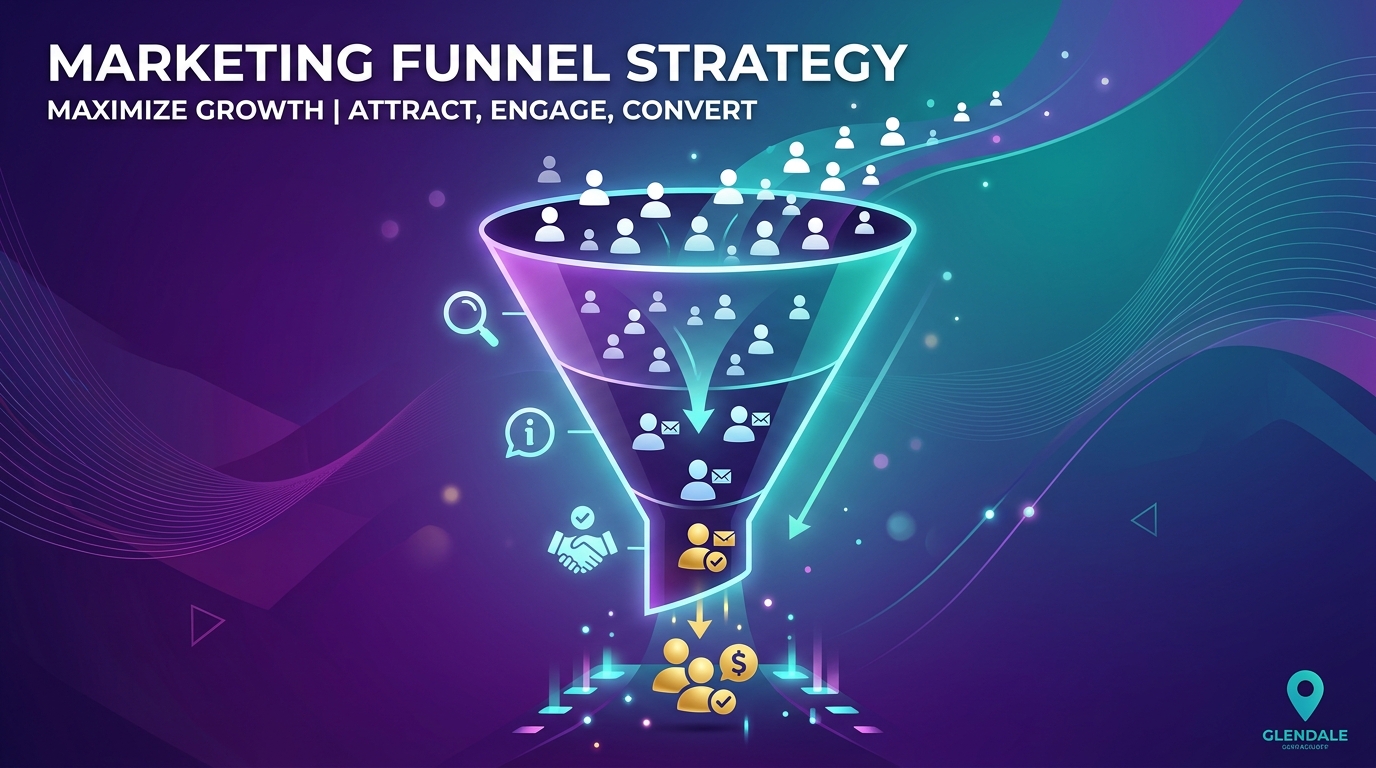
Marketing Funnel Strategy Glendale: How to Turn Traffic Into Leads and Customers
Getting more website traffic is useful, but traffic alone doesn't guarantee business growth.
A visitor can discover your business through Google, social media, paid advertising, or another channel and still leave without taking action.
That's where a marketing funnel strategy Glendale businesses can use becomes important.
A marketing funnel helps you understand the different stages a potential customer moves through—from first discovering your business to becoming a lead and eventually making a purchase.
Instead of treating every visitor the same, you can create content, offers, and campaigns that match what people need at each stage.
What Is a Marketing Funnel?
A marketing funnel is a framework that describes the customer journey from initial awareness to conversion and, ideally, repeat business.
A simple funnel can be divided into four stages:
- Awareness
- Consideration
- Conversion
- Retention
Not every customer follows these stages in a perfectly straight line.
Someone may discover your business today, visit your website next week, compare competitors, and return through a paid advertisement before contacting you.
The funnel is therefore best viewed as a way to understand customer behavior rather than a rigid sequence.
1. Awareness: Get the Right People to Notice You
The first stage is awareness.
At this point, potential customers may know they have a problem but may not know your business exists.
Your goal is to reach relevant people and give them a reason to pay attention.
Common awareness channels include:
- Organic search
- Social media
- Paid advertising
- Video content
- Blog content
- Local search
- Referrals
- Industry publications
The important word is relevant.
Getting thousands of visitors who have no interest in your product or service won't necessarily create meaningful growth.
A smaller audience with strong buying potential can be more valuable.
2. Consideration: Give Visitors a Reason to Stay
Once someone knows about your business, the next question is:
Why should I choose you?
This is the consideration stage.
Your website and content should help potential customers understand:
- What you offer
- Who you serve
- How your solution works
- What makes you different
- What results you can provide
- Why they should trust your business
Useful consideration-stage content can include:
- Service pages
- Comparison guides
- Case studies
- Testimonials
- Demonstrations
- Educational blog posts
- FAQs
- Detailed product information
At this stage, the goal isn't always to make an immediate sale.
It is to reduce uncertainty.
3. Conversion: Turn Interest Into Action
A potential customer may understand your offer and still do nothing.
This is where conversion strategy matters.
Your website should make the next step obvious.
Depending on your business model, that might mean:
- Requesting a quote
- Booking a consultation
- Calling your business
- Completing a form
- Making a purchase
- Starting a trial
- Scheduling an appointment
A strong conversion path should minimize unnecessary friction.
For example, if a visitor has already decided they want more information, don't make them search through several pages to find your contact form.
Make the next action easy to identify.
4. Retention: What Happens After Conversion?
The funnel shouldn't end when someone becomes a customer.
Existing customers can provide significant long-term value.
Retention strategies may include:
- Email communication
- Customer education
- Loyalty programs
- Follow-up campaigns
- Personalized offers
- Customer support
- New product recommendations
Satisfied customers can also become repeat buyers and brand advocates.
That means retention can influence both revenue and future acquisition.
How Traffic Fits Into the Funnel
Different traffic sources can support different stages.
For example:
Search traffic can introduce people looking for solutions.
Social media can build awareness and engagement.
Paid advertising can reach specific audiences with targeted offers.
Email marketing can nurture people who aren't ready to buy immediately.
Referral traffic can introduce your business through an existing relationship.
The goal isn't to make every channel perform the same job.
Instead, build a system where channels work together.
Build Landing Pages Around User Intent
One common funnel mistake is sending every visitor to the homepage.
A homepage has to serve many purposes.
A focused landing page can be much more effective for a specific campaign.
For example, a paid advertisement promoting a particular service should ideally lead to a page that reinforces the same:
- Offer
- Message
- Audience
- Problem
- Call to action
This creates a more consistent journey from advertisement to conversion.
Create Different Content for Different Funnel Stages
One piece of content can't effectively answer every customer question.
Your content should reflect where someone is in their decision-making process.
Awareness Content
Examples:
- “What Is Performance Marketing?”
- Educational guides
- Industry trends
- Problem-focused articles
Consideration Content
Examples:
- Service comparisons
- Case studies
- Detailed guides
- Product or service explanations
Conversion Content
Examples:
- Pricing information
- Consultation pages
- Testimonials
- Service landing pages
- Product pages
Retention Content
Examples:
- Customer guides
- Tutorials
- Product updates
- Exclusive offers
- Follow-up emails
This approach helps prevent your entire content strategy from becoming overly promotional.
Use Lead Magnets to Capture Interested Visitors
Not every visitor is ready to buy.
A lead magnet can provide value in exchange for contact information.
Examples include:
- Checklists
- Guides
- Templates
- Calculators
- Reports
- Free consultations
- Educational resources
The best lead magnet solves a specific problem for a specific audience.
For example, a generic “Digital Marketing Guide” may be less compelling than a focused resource addressing a particular business challenge.
Build a Lead Nurturing Process
Capturing a lead is only the beginning.
Some prospects need additional information before they're ready to purchase.
Lead nurturing can include:
- Follow-up emails
- Educational content
- Case studies
- Product information
- Retargeting campaigns
- Personalized communication
The objective is to remain useful while helping prospects move closer to a decision.
This is particularly important for services with longer buying cycles.
Use Retargeting to Reconnect With Visitors
Some visitors will leave without converting.
That doesn't necessarily mean they aren't interested.
Retargeting can help businesses reconnect with eligible visitors through advertising platforms.
For example, someone who visits a service page but doesn't submit a form may later see an advertisement reminding them about the service.
Retargeting works best when the message matches the visitor's previous interaction rather than showing the same generic advertisement to everyone.
Measure Every Stage of the Funnel
A funnel should be measurable.
Track metrics based on the stage you're evaluating.
Awareness
- Impressions
- Reach
- Website traffic
- Video views
Consideration
- Engagement
- Time on page
- Content interactions
- Returning visitors
Conversion
- Leads
- Sales
- Conversion rate
- Cost per lead
- Revenue
Retention
- Repeat purchases
- Customer retention
- Customer lifetime value
The goal is to identify where potential customers are dropping out.
For example, if traffic is increasing but leads aren't, the problem may be the conversion stage rather than the traffic source.
Optimize the Biggest Bottleneck First
You don't need to change everything at once.
Look for the biggest weakness in your funnel.
For example:
High traffic + low engagement
→ Review targeting and content.
High engagement + few leads
→ Review offers and CTAs.
Many leads + few customers
→ Review lead quality, nurturing, sales process, or offer.
Good sales + poor retention
→ Improve customer experience and follow-up.
This makes optimization more focused and measurable.
How Performance Marketing Fits Into a Funnel
Performance Marketing Glendale businesses can use focuses heavily on measurable outcomes.
Rather than looking only at impressions or clicks, performance-focused campaigns can be evaluated against metrics such as:
- Leads
- Sales
- Cost per acquisition
- Conversion rate
- Revenue
- Return on advertising spend
Paid advertising can support multiple funnel stages, but campaign objectives should match the stage you're targeting.
An awareness campaign shouldn't necessarily be judged by the same metrics as a lead-generation campaign.
Growth Requires More Than More Traffic
Growth marketing Glendale strategies typically look beyond individual campaigns.
Growth comes from continuously testing and improving different parts of the customer journey.
That can involve testing:
- Headlines
- Landing pages
- Offers
- CTAs
- Ad creative
- Audience targeting
- Email sequences
- Content formats
Small improvements across multiple stages can compound over time.
The goal is to create a system that becomes more efficient as you learn what works.
When Should You Work With a Lead Generation Company?
Businesses may benefit from professional support when they are generating traffic but not enough qualified inquiries.
A lead generation company Glendale businesses work with can help identify weaknesses across the acquisition and conversion process.
This can include:
- Audience targeting
- Paid campaigns
- Landing pages
- Lead magnets
- Conversion optimization
- Retargeting
- Lead nurturing
- Performance measurement
The important point is that lead generation shouldn't operate separately from the rest of the funnel.
If advertising generates leads but the website fails to convert visitors, increasing the advertising budget may simply increase wasted traffic.
Conclusion
A marketing funnel gives businesses a practical way to understand how people move from discovering a brand to becoming customers.
The most effective strategy isn't simply about generating more traffic.
It's about attracting the right audience, providing useful information, creating clear conversion paths, nurturing interested prospects, and measuring results at every stage.
Start by identifying the biggest gap in your existing funnel.
Then improve that stage before moving to the next.
With consistent testing and measurement, your funnel can become a more predictable system for turning attention into leads and leads into customers.
Frequently Asked Questions
What is a Marketing Funnel Strategy Glendale businesses can use?
A marketing funnel strategy Glendale businesses can use maps the customer journey from awareness to consideration, conversion, and retention, helping businesses create appropriate marketing activities for each stage.
How do I turn website traffic into leads?
Create focused landing pages, clear calls to action, useful offers, lead magnets, and simple conversion paths. Then measure which traffic sources generate qualified leads.
What is the difference between traffic and leads?
Traffic represents people visiting your website or digital properties. Leads are people who take a meaningful action, such as submitting a form, requesting information, or booking a consultation.
How can paid advertising support a marketing funnel?
Paid advertising can generate awareness, drive qualified traffic, promote offers, support lead generation, and reconnect with previous visitors through retargeting.
What should I measure in a marketing funnel?
Measure metrics appropriate to each stage, including traffic and reach for awareness, engagement for consideration, leads and sales for conversion, and repeat purchases or retention for existing customers.
How long does it take to build an effective marketing funnel?
The timeline depends on the business, sales cycle, traffic sources, website, offer, and available data. Building the funnel is only the beginning; continuous testing and optimization are usually necessary.


