

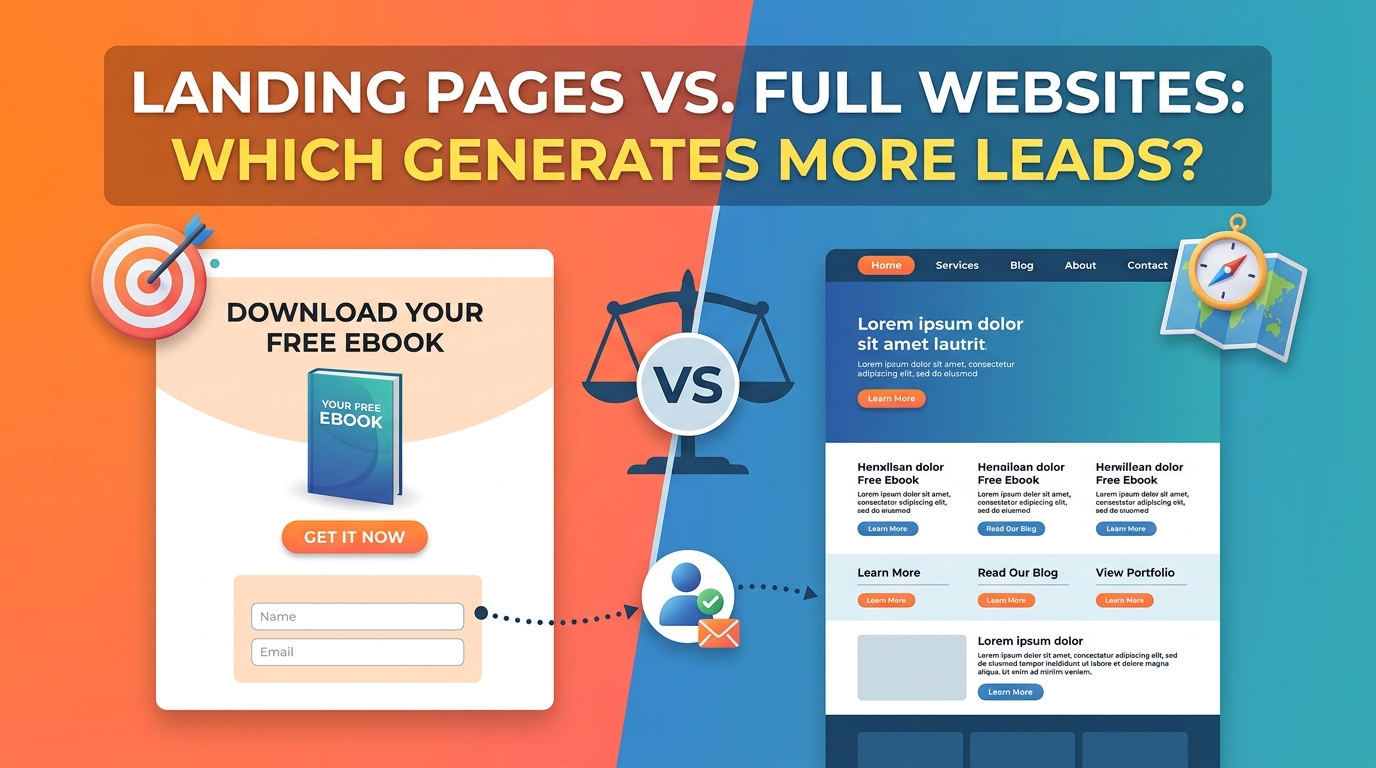
Landing Pages vs. Full Websites: What Does Your Business Actually Need to Generate Leads?
A business website does not always need dozens of pages to generate leads.
Sometimes, a focused landing page can turn visitors into enquiries more effectively than a large website. In other cases, a full website is essential because customers need more information before they decide to contact you.
So, which one does your business actually need?
The answer depends on your goals, audience, traffic sources, and the type of decision you want visitors to make.
This guide explains the difference between landing pages and full websites, when each option makes sense, and how you can decide which approach is right for your business.
What Is a Landing Page?
A landing page is a focused web page designed around a specific goal.
That goal could be to:
- Generate leads
- Get phone calls
- Collect form submissions
- Promote a service
- Encourage bookings
- Download a resource
- Register users for an event
- Promote a special offer
Unlike a typical website page, a landing page usually has fewer distractions.
For example, a business running Google Ads for a specific service might send visitors to a dedicated page that explains that service and encourages them to request a quote.
This is where landing page design services Beverly Hills can be valuable. The page can be designed around one audience, one offer, and one primary action.
What Is a Full Website?
A full business website is a larger online presence made up of multiple pages.
It may include:
- Homepage
- About page
- Service pages
- Product pages
- Contact page
- Blog
- Case studies
- Testimonials
- FAQs
- Location pages
The purpose is broader than simply generating one conversion.
A full website can help people learn about your company, understand your services, compare options, and decide whether they trust your business.
For companies that need a strong long-term online presence, professional website design Glendale can help create a website that supports both users and business goals.
Landing Page vs. Full Website: The Main Difference
The simplest difference is focus.
A landing page is usually built around one specific conversion goal.
A full website gives visitors more freedom to explore.
Think of it this way:
Landing page:
“Here is the offer. Here is why it matters. Here is what to do next.”
Full website:
“Here is who we are, what we offer, why you can trust us, and everything else you may want to know.”
Neither approach is automatically better.
The right choice depends on what you are trying to achieve.
When Should You Use a Landing Page?
1. You are running a paid advertising campaign
Landing pages can work particularly well with paid advertising.
Imagine someone searches Google for a specific service and clicks your ad.
Instead of sending them to a general homepage, you could send them to a page specifically designed around the service they searched for.
The message is more closely matched to their intent.
That can make the visitor's journey simpler.
2. You are promoting one specific service
A dedicated landing page can focus entirely on one service.
Instead of asking visitors to navigate through your website to find the information they need, everything relevant can be placed on one page.
The page might include:
- The problem
- Your solution
- Benefits
- Social proof
- Pricing information, if appropriate
- FAQs
- A call to action
3. You are testing an offer
Landing pages are also useful for testing.
You might want to compare:
- Different headlines
- Offers
- Calls to action
- Images
- Form lengths
- Messaging
This can help you learn what resonates with your audience.
4. You need a campaign-specific page
A business might create a landing page for:
- A seasonal promotion
- A webinar
- A new service
- A downloadable guide
- A local campaign
- A product launch
The page can then be removed, updated, or reused when the campaign ends.
When Should You Build a Full Website?
1. You need to establish credibility
People often research a company before contacting it.
They may want to know:
- Who runs the business
- How long it has been operating
- What services it provides
- Where it is located
- What customers say about it
- How they can contact the company
A full website gives you room to answer those questions.
This is particularly important for businesses where customers need to build trust before making a purchase.
2. You offer multiple services
If your company provides several different services, putting everything onto one landing page can make the experience confusing.
A full website allows you to give each service its own dedicated page.
This can also make it easier to create content that targets different search terms and customer needs.
3. You want to build organic search visibility
SEO often requires more than one page.
A website with useful service pages, location pages, educational content, FAQs, and other relevant resources can create more opportunities to appear in search results.
A landing page can target a specific search intent, but a full website gives your business a broader platform for organic growth.
4. You need a long-term digital presence
A full website is generally the better foundation if your website will be an important business asset for years.
You can add new services, publish content, create new pages, and improve the user experience as your business grows.
Can You Use Both?
Yes.
In fact, many businesses should.
Your full website can act as your central online presence, while landing pages can support specific marketing campaigns.
For example:
Full website
- Homepage
- About
- Services
- Case studies
- Blog
- Contact
Campaign landing pages
- Google Ads campaign
- Facebook campaign
- New service launch
- Promotional offer
- Lead magnet
This approach gives you the best of both worlds.
Your main website provides information and credibility, while landing pages provide focused conversion experiences.
What Makes a Landing Page Convert?
Having a landing page is not enough.
The page needs to make it easy for visitors to understand what you offer and what they should do next.
A clear headline
Visitors should immediately understand what the page is about.
Avoid vague headlines that make people work to understand your offer.
One main goal
Don't give visitors ten different actions.
If the goal is to generate enquiries, make the enquiry process obvious.
Strong benefits
Don't only describe what you sell.
Explain how it helps the customer.
Trust signals
Depending on your business, you might include:
- Customer reviews
- Testimonials
- Case studies
- Certifications
- Guarantees
- Client logos
A simple call to action
Tell visitors exactly what to do.
Examples include:
- Request a Quote
- Book a Consultation
- Call Today
- Get Started
- Schedule a Demo
What Makes a Full Website Effective?
A full website needs to do more than look attractive.
Good website design should consider the complete user journey.
That includes:
Clear navigation
Visitors should be able to find important information without searching through complicated menus.
Mobile responsiveness
Your website should work properly across phones, tablets, laptops, and desktop screens.
Fast performance
Slow pages can create a poor user experience and may cause visitors to leave before they contact you.
Strong service pages
Each important service should have enough information to help visitors understand what you provide and why they should choose you.
Clear conversion paths
Even a large website should make it easy for visitors to take action.
Every page does not need to be a landing page, but important pages should give visitors a logical next step.
Landing Page Development vs. Website Development
Design is only part of the process.
Landing page development Beverly Hills may involve building forms, tracking, integrations, responsive layouts, analytics, and other conversion-focused functionality.
A full website may require a broader technical structure, including a content management system, custom features, integrations, and ongoing maintenance.
For businesses with unique requirements, custom web design services Beverly Hills can provide more control over the site's design and functionality.
The right development approach depends on the project's goals rather than simply choosing the most advanced technology.
How Do You Decide Which One You Need?
Ask yourself these questions:
What is the immediate goal?
If you need leads for one specific campaign, a landing page may be enough.
If you need to establish your overall online presence, a full website is probably the better starting point.
Where will your traffic come from?
Paid advertising often works well with dedicated landing pages.
Organic search, referrals, branded searches, and direct traffic may require a broader website experience.
How much information do customers need?
If customers need to research your company and services before contacting you, a full website can provide that information.
Do you offer multiple services?
If yes, a full website with dedicated service pages may be more practical.
Are you testing a specific offer?
A landing page can make testing easier because you can isolate one message and one conversion goal.
Which Option Is Right for Your Business?
There is no universal answer.
For many businesses, the smartest approach is not landing page vs. website.
It is landing pages + a strong website.
Need Help Building a Website That Generates Leads?
Your website should support the way your customers actually make decisions.
Whether you need a focused campaign page or a complete business website, the right structure should connect your messaging, design, user experience, and conversion goals.
A professional team can help determine whether landing page design services or a broader website solution makes more sense for your business.
Friday Marketing Agency provides website design, development, digital marketing, AI content creation, social media, and advertising services. If you're unsure whether you need a landing page, a full website, or both, the team can help you plan an approach around your goals and audience.
Ready to turn more website visitors into leads? Start with the right digital experience for your business.
Frequently Asked Questions
Is a landing page better than a full website for lead generation?
Not always. A landing page can be highly effective for focused campaigns, while a full website can generate leads through multiple service pages, organic search, content, and different conversion paths.
Can a business have a landing page without a website?
Yes. A business can use a standalone landing page for a specific campaign or offer. However, having a full website can provide additional credibility and information for people researching the business.
How many landing pages should a business have?
There is no fixed number. The number should depend on your campaigns, services, audiences, and offers. Different campaigns may benefit from different landing pages.
What should a lead generation landing page include?
A strong lead generation landing page generally needs a clear headline, relevant offer, benefits, trust signals, supporting information, and a clear call to action.
Can landing pages help with Google Ads?
Yes. A dedicated landing page can create a closer connection between an advertisement, the searcher's intent, and the page content. This can provide a more focused experience than sending every visitor to a generic homepage.
Do I need a full website for SEO?
A full website is generally more useful for a broader SEO strategy because it provides space for service pages, educational content, location pages, and other relevant resources. A single landing page can still target a specific search intent.
What is the difference between landing page design and development?
Landing page design focuses mainly on the visual layout, messaging, user experience, and conversion structure. Development turns that design into a functioning page and may include forms, integrations, tracking, responsiveness, and other technical features.
Are landing pages suitable for small businesses?
Yes. A landing page can be a practical option for a small business running a specific promotion, advertising campaign, or lead generation strategy. As the business grows, it may benefit from adding a complete website.


