

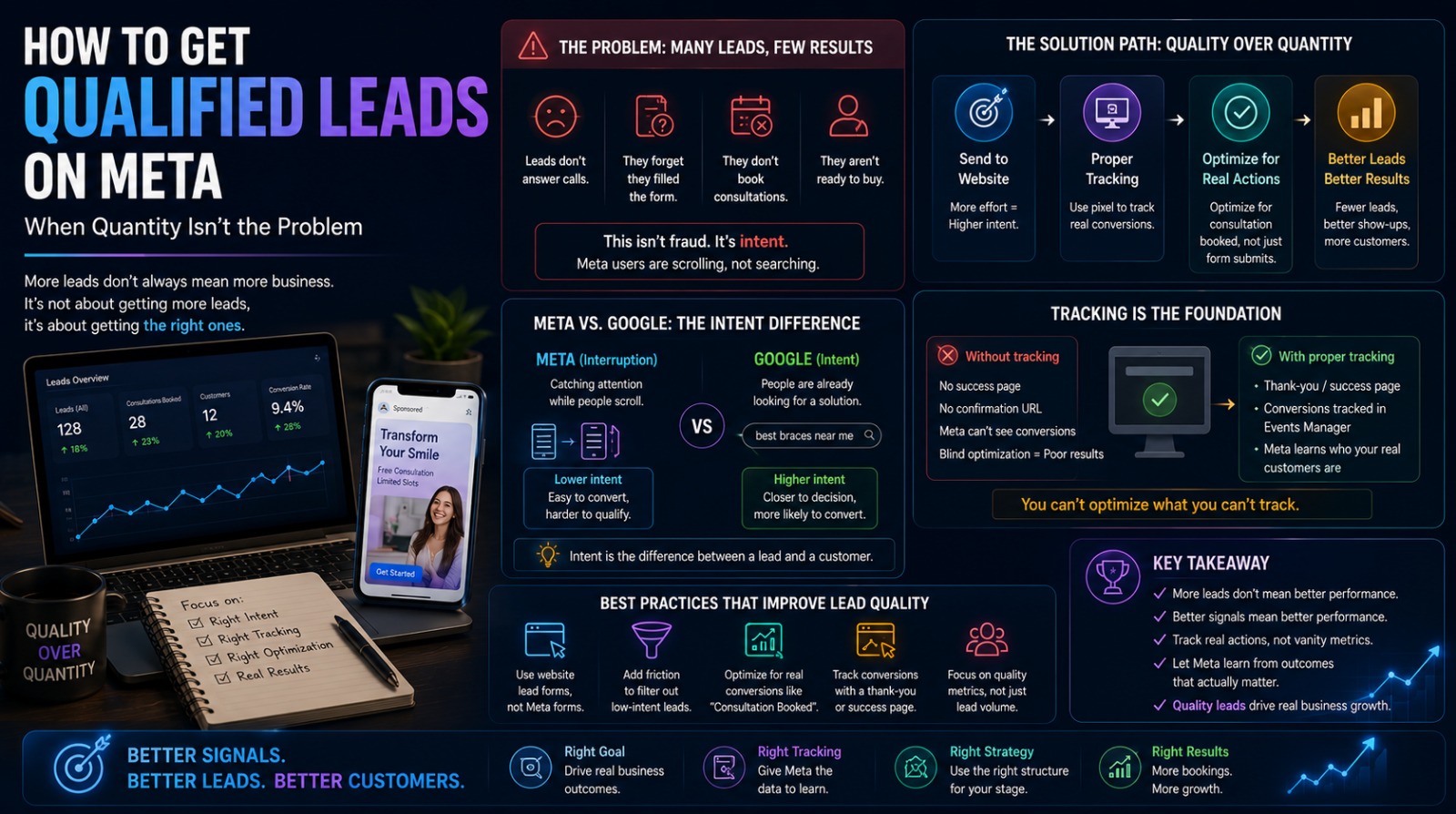
How to Get Qualified Leads on Meta
When Quantity Isn’t the Problem
Getting leads on Meta is rarely the hard part.
Getting qualified leads people who actually show up, book, and become real clients — is where most brands struggle.
This becomes especially clear when you compare Meta to other channels like Google Ads. On paper, everything can look fine: ads are running, leads are coming in, and forms are filled out. But when you zoom in, the reality is different. Very few of those leads turn into real consultations, and even fewer into customers.
That gap between numbers and results is where most Meta lead strategies quietly fail.

When Lead Volume Looks Good, but Quality Doesn’t
In many service-based businesses — orthodontics, medical services, beauty, local services — Meta lead forms often generate volume. Dozens of leads per month are not unusual. The problem is what happens next.
Leads don’t answer calls.
They forget they ever filled out a form.
They don’t book consultations.
They aren’t ready to buy.
Even after checking that leads are real people from the correct location and not spam or bots, the conversion rate stays low. This is a common pattern, especially when using Meta instant forms, particularly on Instagram.
The issue here is not fraud.
Its intent.
Meta users are usually scrolling, not searching. Filling out a form inside the app is easy, fast, and often done without much thought. That ease is exactly why quality drops.
Why Google Often Converts Better Than Meta
When Google Ads perform better, it’s usually for one simple reason:
People are already looking for a solution.
Someone searching for braces, aligners, or a consultation is already closer to making a decision. When that traffic is connected to a CRM system that books consultations directly, the path is clear and measurable.
Meta, on the other hand, is interruption-based. You’re catching attention, not fulfilling an active search. That means the structure around the ad matters much more.
The Real Problem: What You Optimize For
One of the biggest mistakes in Meta lead campaigns is optimizing for the wrong action.
If you optimize for form submissions, Meta will find people who like filling out forms — not people who want consultations.
This is why many experienced marketers recommend moving away from Meta forms and pushing users to the website instead. A website requires more effort. That effort filters people. Fewer leads, yes — but much better ones.
Website Leads Change Everything
When leads come through the website, you gain two major advantages:
1. Higher intent
Clicking an ad, landing on a website, reading content, and submitting a form is a stronger signal than tapping a form inside Instagram.
2. Better tracking and optimization
With the Meta pixel properly set up, you can optimize for a real business goal — like “free consultation booked” — instead of a shallow lead action.
This is where Meta starts to behave very differently.
Tracking Is Not Optional — It’s the Foundation
One of the most common technical blockers is tracking conversions properly.
Many websites use third-party systems for booking or form submissions. Often, after someone submits a form, nothing happens that Meta can clearly track — no redirect, no unique success page, no confirmation URL.
From Meta’s point of view, the action never really happened.
Without a clear conversion signal, Meta cannot learn who your real customers are. It will keep optimizing blindly, sending you more of the same low-quality leads.
The solution is usually simpler than it sounds.
A basic success or thank-you page — even a very simple one — allows Meta Events Manager to track conversions properly. Once that’s in place, you can optimize campaigns for something meaningful, like completed consultation requests.
This is not a “nice to have.”
It’s essential.
Fewer Leads, Better Results
A mindset shift is needed here.
More leads do not mean better performance.
Better signals mean better performance.
When you switch from Meta forms to website conversions, lead volume often drops. That can feel uncomfortable at first. But what usually follows is higher show-up rates, better conversations, and real bookings.
Meta is powerful — but only when you clearly define what success looks like.
The Bigger Picture
Qualified leads on Meta don’t come from tricks, hacks, or aggressive targeting changes. They come from:
• Choosing the right conversion goal
• Forcing a small amount of friction
• Tracking real actions, not vanity metrics
• Letting Meta learn from outcomes that actually matter
When Meta understands who books consultations — not who taps a form — the entire system starts working differently.
And that’s when Meta stops being a lead generator and starts becoming a real growth channel.


