

Frontend vs Backend Development: What’s the Difference and Why Do Websites Need Both?
When you visit a website, you see the pages, buttons, images, menus and forms in front of you. But there is much more happening behind the scenes.
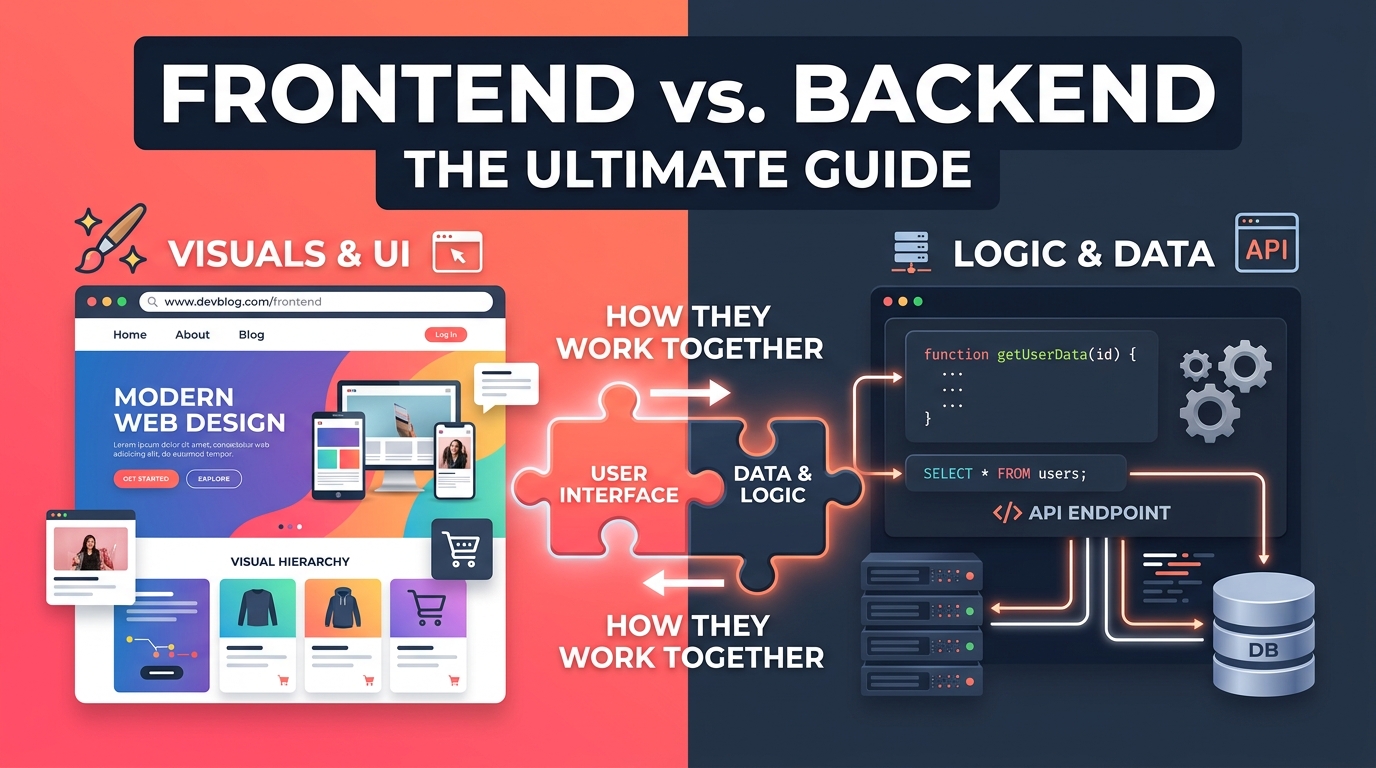
A modern website needs both a frontend and a backend to work properly. The frontend controls what visitors see and interact with, while the backend handles the systems and data that make those experiences possible.
Understanding the difference can help business owners make better decisions when planning a new website, improving an existing one or hiring a development team.
In this guide, we’ll explain frontend and backend development in simple terms, how they work together and why both matter.
What Is Frontend Development?
Frontend development focuses on the part of a website that visitors see and use.
It includes the visual interface and the interactive elements that appear in a browser.
For example, when you visit a business website, the following are usually part of the frontend:
- Navigation menus
- Buttons
- Images
- Text
- Forms
- Product pages
- Animations
- Page layouts
- Mobile menus
- Interactive features
Frontend developers use technologies such as HTML, CSS and JavaScript to create these experiences.
The goal is not simply to make a website look attractive. The frontend should also be fast, accessible, responsive and easy to use.
This is where frontend development services Glendale can help businesses create a website experience that works across different devices and screen sizes.
What Is Backend Development?
Backend development focuses on the technology working behind the website.
Visitors may not see the backend directly, but it is responsible for many of the functions that make a website work.
A backend can handle:
- Databases
- User accounts
- Website security
- Form submissions
- Payments
- Business logic
- APIs
- Content management
- User permissions
- Data processing
For example, imagine you are shopping on an online store.
You click "Add to Cart" on a product. The frontend shows the button and updates the page. Behind the scenes, the backend may process the request, communicate with a database and keep track of your shopping cart.
Without the backend, many modern websites would not be able to perform these tasks.
Frontend vs Backend: What's the Difference?
The simplest way to understand the difference is to think of a restaurant.
The frontend is similar to the dining area. It is what customers see and interact with.
The backend is similar to the kitchen. Customers may not see everything happening there, but it is responsible for preparing and processing what the customer orders.
A website works similarly.
Both sides need to work together for the website to deliver a complete experience.
What Technologies Are Used for Frontend Development?
Frontend developers use several technologies to create websites and web applications.
HTML
HTML provides the basic structure of a webpage.
It defines elements such as headings, paragraphs, links, images and forms.
CSS
CSS controls how those elements look.
It can determine colours, spacing, fonts, layouts and responsive behaviour.
JavaScript
JavaScript adds interaction and dynamic functionality.
For example, JavaScript can help power dropdown menus, sliders, interactive forms and other browser-based features.
Developers may also use frontend frameworks and libraries to build more complex applications efficiently.
What Technologies Are Used for Backend Development?
Backend development uses different technologies because it deals with server-side operations.
Common backend technologies include programming languages and frameworks such as:
- PHP
- Python
- JavaScript/Node.js
- Java
- Ruby
- .NET
The appropriate technology depends on the website's requirements.
A backend may also connect to databases such as MySQL, PostgreSQL or MongoDB.
The important thing is not simply which technology is used. The development approach should match the project's needs, security requirements and future growth.
Why Do Websites Need Both Frontend and Backend?
For most modern websites, frontend and backend development work together.
Consider a business website with a contact form.
The frontend allows the visitor to enter their name, email address and message.
When they click "Submit", the backend can receive that information, validate it, store it or send it to the appropriate system.
The visitor sees the result through the frontend, while the backend handles the processing.
This relationship becomes even more important for websites with advanced features.
An online store, for example, may need to manage:
- Customer accounts
- Product information
- Stock levels
- Shopping carts
- Orders
- Payments
- Shipping information
The frontend provides the customer experience. The backend manages the systems supporting it.
What Are Full Stack Development Services?
Full stack development services in Glendale cover both frontend and backend development.
A full-stack developer understands the technologies used to build the user-facing side of a website as well as the systems behind it.
This can be useful for businesses that need a complete web development solution.
A full-stack approach can help teams coordinate different parts of a project because the developer understands how the frontend and backend need to communicate.
However, larger or more complex projects may still involve separate specialists for design, frontend, backend, databases, security and other areas.
When Do You Need Frontend Development?
Almost every modern business website needs frontend development.
You may need professional frontend work if:
Your website isn't mobile-friendly
Visitors increasingly access websites from smartphones and tablets. Your pages need to adapt to different screen sizes.
Your website is difficult to navigate
A confusing layout can make it harder for visitors to find information or complete important actions.
Your website looks outdated
An older interface may not reflect your current brand or provide the experience your customers expect.
You need interactive features
Complex forms, calculators, filters, animations and other features may require custom frontend development.
Your website is slow
Frontend code, images, scripts and other elements can affect page performance. Optimising them can help create a faster experience.
When Do You Need Backend Development?
Backend development becomes particularly important when your website needs to process information or connect to other systems.
You may need backend development for:
- Customer login systems
- Online payments
- E-commerce
- Booking platforms
- Membership websites
- Custom dashboards
- CRM integrations
- Databases
- APIs
- Personalised user experiences
A simple informational website may have limited backend requirements, while a web application could depend heavily on backend systems.
How Frontend and Backend Developers Work Together
Frontend and backend developers need to communicate throughout a project.
The frontend might need information from the backend. The backend needs to understand what information the frontend requires.
For example, consider a property search website.
The frontend may allow visitors to choose a location and price range. The backend can process those selections, search the database and return matching properties.
The frontend then displays the results.
This communication often happens through APIs.
When both sides are planned together, businesses can avoid problems such as slow performance, broken functionality and inconsistent user experiences.
Why Your Development Agency Matters
Choosing a web development agency in Glendale is not only about finding someone who can write code.
Your development partner should understand your business goals and how your website supports them.
Before choosing an agency, consider asking:
- What development services do you provide?
- Can you work with our existing website?
- How do you approach mobile responsiveness?
- How do you test website functionality?
- How do you handle security?
- Can you integrate third-party systems?
- How will the website be maintained after launch?
- Can the website be expanded in the future?
A good development process should consider both what visitors see and what happens behind the scenes.
How Friday Marketing Can Help
A successful website needs more than attractive pages. It needs technology that supports your customers and business goals.
Friday Marketing combines data, creativity and technology to help businesses grow online. Its website services include site mapping and wireframing, content writing, UI/UX design, custom development and CMS development.
If your website needs a better user experience, custom functionality or a stronger technical foundation, the Friday Marketing team can help you explore the right approach.
Whether you need frontend work, backend functionality or a complete web development project, the focus should be on creating a website that is useful for your customers and your business.
Explore Friday Marketing Agency's website services
Frequently Asked Questions
What is the difference between frontend and backend development?
Frontend development focuses on what website visitors see and interact with. Backend development manages the server, database, business logic and other systems working behind the website.
Is frontend or backend development more important?
Neither is more important. They serve different purposes and need to work together. A good frontend without a reliable backend can fail to deliver functionality, while a strong backend needs an effective frontend for users to interact with it.
What are Frontend Development Services Glendale?
Frontend development services Glendale involve creating and improving the user-facing parts of websites and web applications, including layouts, navigation, interactions and responsive experiences.
What are Backend Development Services Glendale?
Backend development services Glendale focus on server-side functionality such as databases, APIs, authentication, business logic and data processing.
What is full stack development?
Full stack development involves working across both frontend and backend technologies. A full-stack developer can help build the user interface and the systems supporting it.
Does every website need backend development?
Not every website needs a complex backend. A simple informational website may have limited server-side functionality, while e-commerce stores, booking platforms and web applications usually require more extensive backend development.
Can frontend development improve website performance?
Yes. Optimised code, efficient assets, responsive layouts and good development practices can contribute to a faster and smoother website experience.
How do I choose a web development agency?
Look for an agency that understands your business goals, has experience with the technologies you need and can provide a clear development and maintenance plan.


