

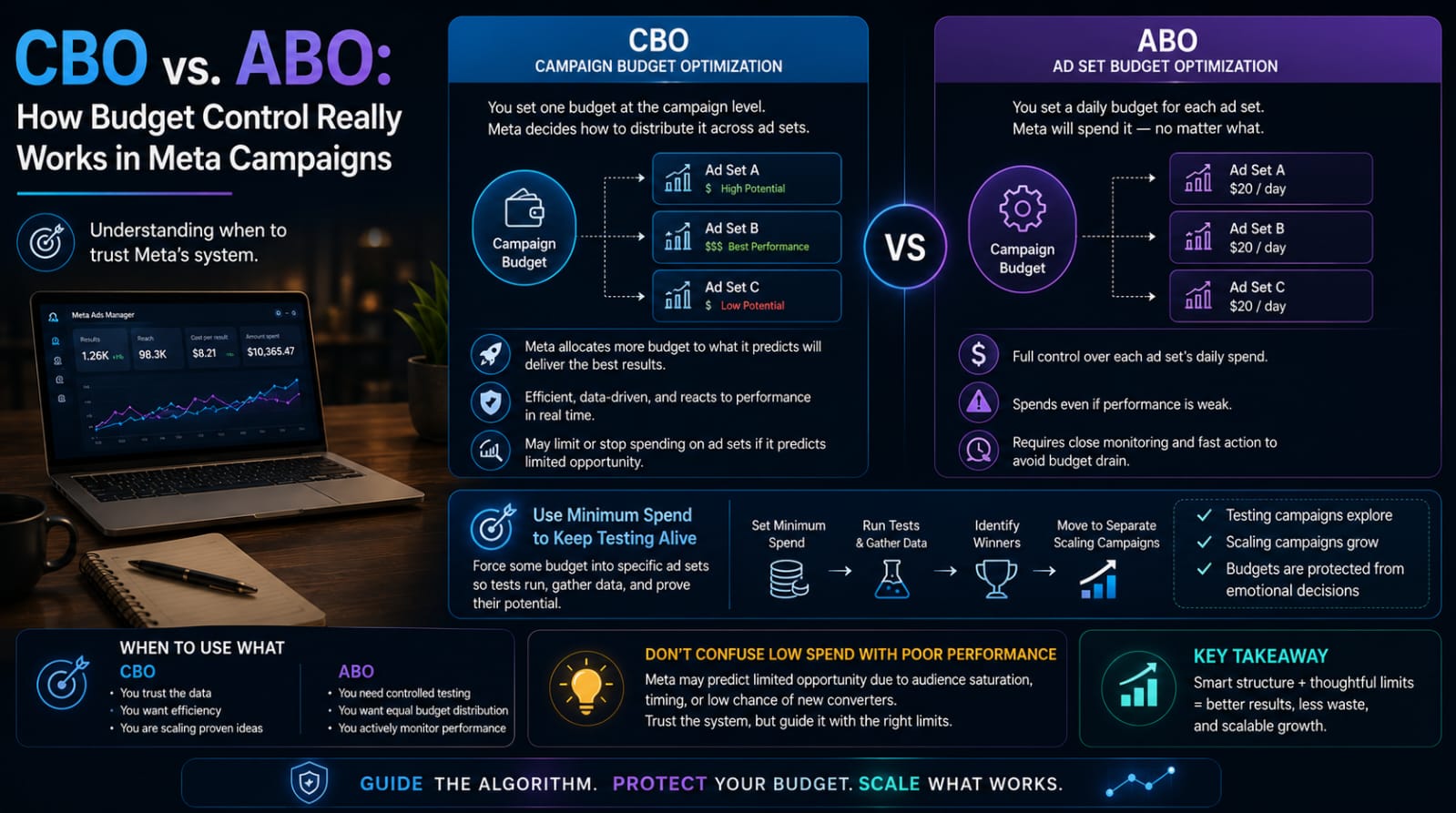
CBO vs. ABO: How Budget Control Really Works in Meta Campaigns
Understanding when to trust Meta’s system.
When managing Meta campaigns, one of the most important decisions is how to control your budget. At first glance, Campaign Budget Optimization (CBO) and Ad Set Budget Optimization (ABO) may seem like simple technical choices. In reality, they reflect two very different approaches to how much control you give the platform and how much responsibility you keep for yourself.
Understanding this difference is not just about mechanics. It’s about knowing when to trust Meta’s system and when to step in to protect your budget, your tests, and your results.

What Happens When You Use CBO
With CBO, you set one budget at the campaign level and allow Meta to decide how that budget is distributed across ad sets. The system looks at performance signals in real time and sends more money to what it believes will work best.
This can be powerful. Meta is fast, data-driven, and capable of reacting to signals you might not see immediately. When an ad set shows strong potential, CBO can scale it automatically without manual intervention.
However, this also means you are giving Meta more control. The platform is not trying to be fair — it is trying to be efficient. If Meta predicts that an ad set will not find additional customers on a given day, it may limit or completely stop spending on that ad set, even if its return on ad spend looks good.
This can feel confusing at first. You might see an ad set with a high ROAS and wonder why it is barely spending. In most cases, it’s not a mistake. It’s Meta deciding that pushing more money into that audience today is unlikely to bring additional results.
Why Low Spend Doesn’t Always Mean a Problem
One common misunderstanding with CBO is assuming that low spend equals poor performance. That’s not always true.
Sometimes, Meta simply predicts a limited opportunity. The audience may be saturated for the day, the timing may not be right, or the likelihood of finding new converters may be low. In those situations, Meta holds back spending — even if past performance looks strong.
This is where many advertisers intervene too quickly. They see low spend and force changes, thinking something is broken. In reality, the system may just be protecting the budget from being wasted.
That said, complete trust is not always the best strategy either.
Using Minimum Spend to Keep Testing Alive
One of the smartest ways to balance control and automation in CBO is by setting a minimum ad set spend. This allows you to force some budget into specific ad sets, even if Meta is hesitant to allocate money to them.
Why is this important?
Because testing matters.
If you always let Meta decide everything, new ideas, new audiences, and new creatives may never get a real chance. Minimum spend ensures that tests actually run, gather data, and prove themselves.
Once a test shows clear signs of success, it doesn’t belong in a testing environment anymore. Winners should be moved into separate scaling campaigns, where budgets are higher and performance expectations are clearer.
This structure keeps your account clean:
- Testing campaigns explore
- Scaling campaigns grow
- Budgets are protected from emotional decisions
The Risk of ABO and Daily Budget Drain
ABO gives you full control. Each ad set has its own daily budget, and Meta will spend it — no matter what.
This can be useful for strict testing, especially when you want equal budget distribution across multiple ad sets. But it comes with a serious risk: ABO spends even when performance is bad.
If an ad set is underperforming, ABO does not slow down automatically. The budget will still be spent daily unless you manually intervene. This requires close monitoring and fast decision-making.
Without discipline, ABO can quietly drain budgets on ad sets that are clearly not working.
Choosing the Right Approach
There is no universal winner between CBO and ABO. The real skill lies in knowing when to use each.
- CBO works best when you trust the data, want efficiency, and are ready to scale proven ideas.
- ABO works best when you need controlled testing and equal budget distribution — but only if you actively monitor performance.
The strongest campaign structures often use both:
- ABO for structured testing
- CBO for scaling winners
- Minimum spend to keep exploration alive
- Clear separation between testing and scaling
Final Thought
Budget optimization is not about control versus automation. It’s about balance.
Meta’s system is powerful, but it doesn’t understand your business goals, timelines, or creative strategy the way you do. Your job is not to fight the algorithm it’s to guide it.
When you combine smart structure with thoughtful limits, both CBO and ABO become tools instead of risks. And that’s when campaign management stops feeling reactive and starts feeling intentional.


