

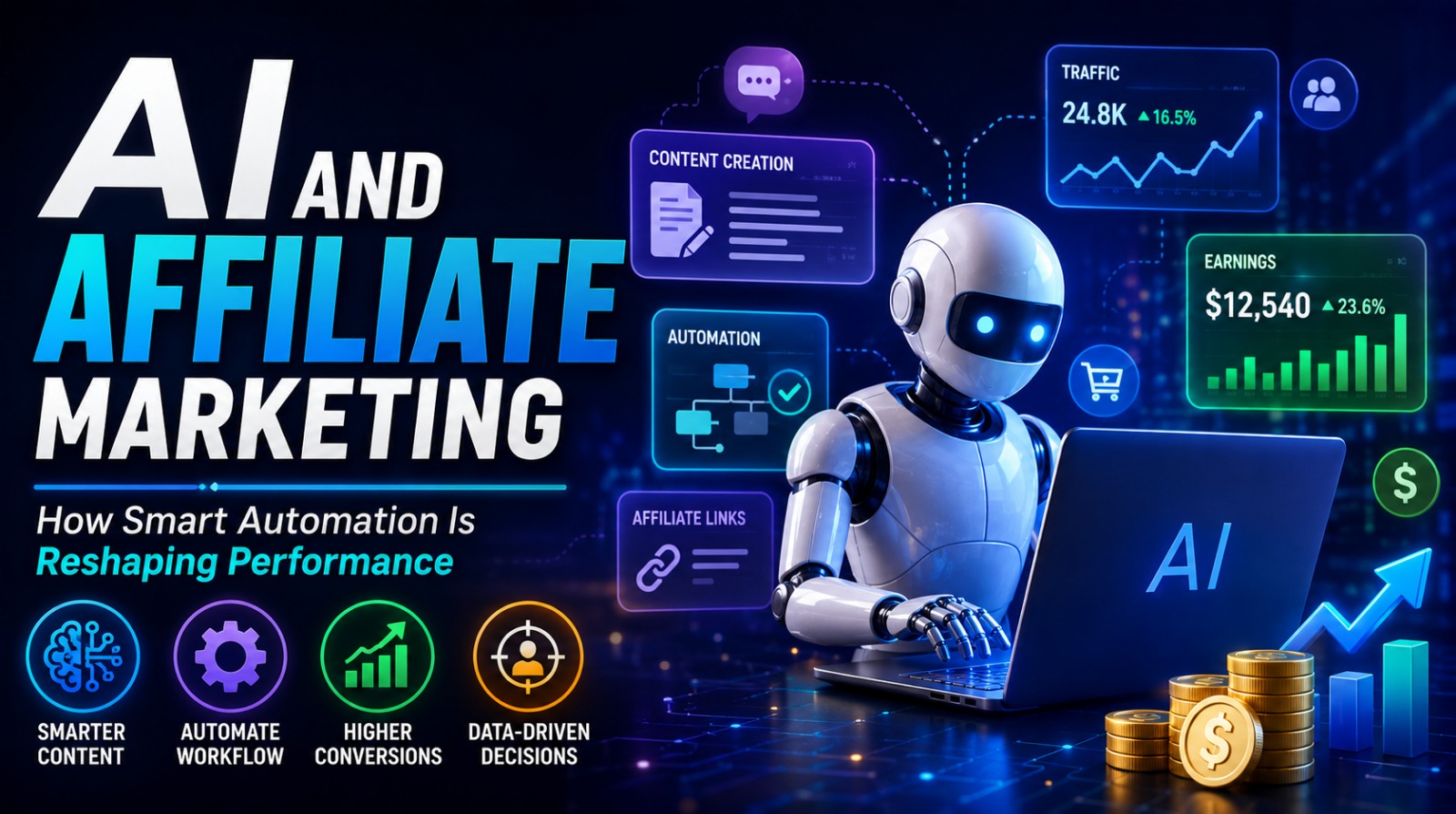
AI and Affiliate Marketing
How Smart Automation Is Reshaping Performance
Affiliate marketing has always rewarded those who test faster, learn quicker, and adapt before others do. What has changed in the last two years is the speed at which this adaptation can happen. Artificial intelligence is no longer a future concept for affiliates it is already embedded in how content is created, optimized, distributed, and measured.
The real question today is not whether AI belongs in affiliate marketing. It’s how to use it without losing trust, originality, or performance.
This article explores where AI actually adds value, which tools are shaping modern affiliate workflows, and how automation can support — not replace — human judgment.

Why AI matters in affiliate marketing — and where it does not
AI is not a shortcut to success. It does not turn weak ideas into profitable systems. What it does well is amplify strong foundations.
Recent industry data shows a sharp rise in AI adoption across marketing teams. Content creation, SEO research, email personalization, and testing cycles that once took days can now be executed in hours. For affiliates, this changes the economics of experimentation. You can test more angles, iterate faster, and respond to user behavior almost in real time.
At the same time, this speed introduces a new risk: sameness. When many publishers rely on identical prompts and automated outputs, content quality drops, trust erodes, and audiences disengage. AI should support thinking, not replace it. The affiliates who win are the ones who combine machine efficiency with lived experience and clear editorial judgment.
The AI toolkit affiliates are actually using today
Rather than focusing on hype, it’s more useful to look at how affiliates are using AI in practice.
Content creation and ideation
Large language models are widely used for outlining articles, generating first drafts, and mapping reader questions. The strongest results are achieved when AI is used to structure content, while humans write introductions, conclusions, and examples that draw on real experience in the niche.
SEO and search intent analysis
AI-powered SEO tools help identify intent gaps and emerging topic opportunities. Instead of chasing high-volume keywords alone, affiliates increasingly focus on specific, high-intent queries that reflect real purchase decisions. AI summaries combined with original data points help create content that stays relevant longer.
Automation and workflow orchestration
Tools like automation platforms connect content creation, CMS publishing, editorial review, and social distribution into a single flow. This reduces manual work and ensures consistency without removing human approval from critical steps.
Personalization and recommendations
More affiliates are experimenting with intent-based recommendations. By matching user behavior or search queries to the most relevant content or product, recommendations feel more helpful and less promotional. Even simple systems can significantly improve engagement and conversion rates.
Tracking, attribution, and link management
AI-supported analytics platforms make it easier to understand what drives conversions across channels. Combined with proper link management and server-side tracking, affiliates gain clearer visibility into performance without relying on guesswork.
Automation strategies that actually improve results
Not all automation is useful. The most effective strategies focus on reducing friction while preserving authenticity.
One common approach is using AI to create structured content frameworks — such as product reviews or comparison guides — and then layering in personal insights, screenshots, or firsthand observations. This combination consistently outperforms fully automated content.
Another effective tactic is AI-assisted localization. Translating content into new markets is fast, but adding local context — payment methods, availability, customer habits is what makes it convert.
In paid media, AI-generated creative variations allow for faster testing cycles. Instead of guessing which headline will perform best, affiliates can test multiple options and let performance data guide decisions.
Email funnels also benefit from AI when used carefully. Personalized sequences based on user behavior or downloaded content feel more relevant, especially when refined using real reply data rather than assumptions.
Growth signals worth paying attention to
Affiliate marketing continues to grow because it remains measurable and performance-driven. Advertisers value channels where ROI is transparent, and affiliates benefit from systems that reward efficiency.
At the same time, generative AI has moved from experimentation to standard practice. This does not mean the bar is lower — it means expectations are higher. Faster production cycles make originality, accuracy, and trust even more important.
Numbers point to opportunity, but they do not guarantee results. The differentiator is how thoughtfully those tools are applied.
Ethics, compliance, and responsibility
Automation increases scale — and scale increases risk.
In regulated industries such as finance, health, or crypto, every claim must be verified. AI-generated content should always be reviewed for accuracy, compliance, and local regulations. Affiliate disclosures are not optional; they are essential for trust and long-term sustainability.
Fabricated testimonials, misleading comparisons, or unverified promises damage credibility and can lead to penalties or bans. Responsible automation means knowing where to slow down, not just where to speed up.
A simple framework before you automate
Before connecting any system end-to-end, it helps to pause and ask:
- Does this improve the user experience or just my efficiency?
- Can factual errors be caught before publishing?
- Are there legal or compliance risks in this niche?
- Can the system handle edge cases without breaking trust?
- Is there a way to monitor, log, and roll back changes if needed?
If the answers are unclear, refining the process first will save far more time than fixing mistakes later.
Where AI is heading next in affiliate marketing
The next phase is not about more content — it’s about better relevance.
Predictive personalization will allow recommendations to adapt within a single session. Search will become more conversational, pushing affiliates to focus on intent mapping rather than keyword density. At the same time, regulation around data usage and AI transparency will continue to evolve, forcing clearer boundaries between personalization and privacy.
Those who prepare early will adapt more smoothly.
Final thoughts
AI is not a replacement for experience, taste, or trust. The strongest affiliate brands treat it as a collaborator — a tool that speeds up execution while humans remain responsible for voice, accuracy, and judgment.
Affiliate marketing has always rewarded patience, testing, and credibility. That hasn’t changed. What has changed is the speed at which good decisions — and bad ones now scale.
The future belongs to those who automate wisely and stay human where it matters most.


